




BEST KNEE SURGERY IN BHOPAL WHY ARTHROSCOPY IS BETTER THAN OPEN SURGERY
Best Knee Surgery in Bhopal: Why Arthroscopy is Better Than Open Surgery
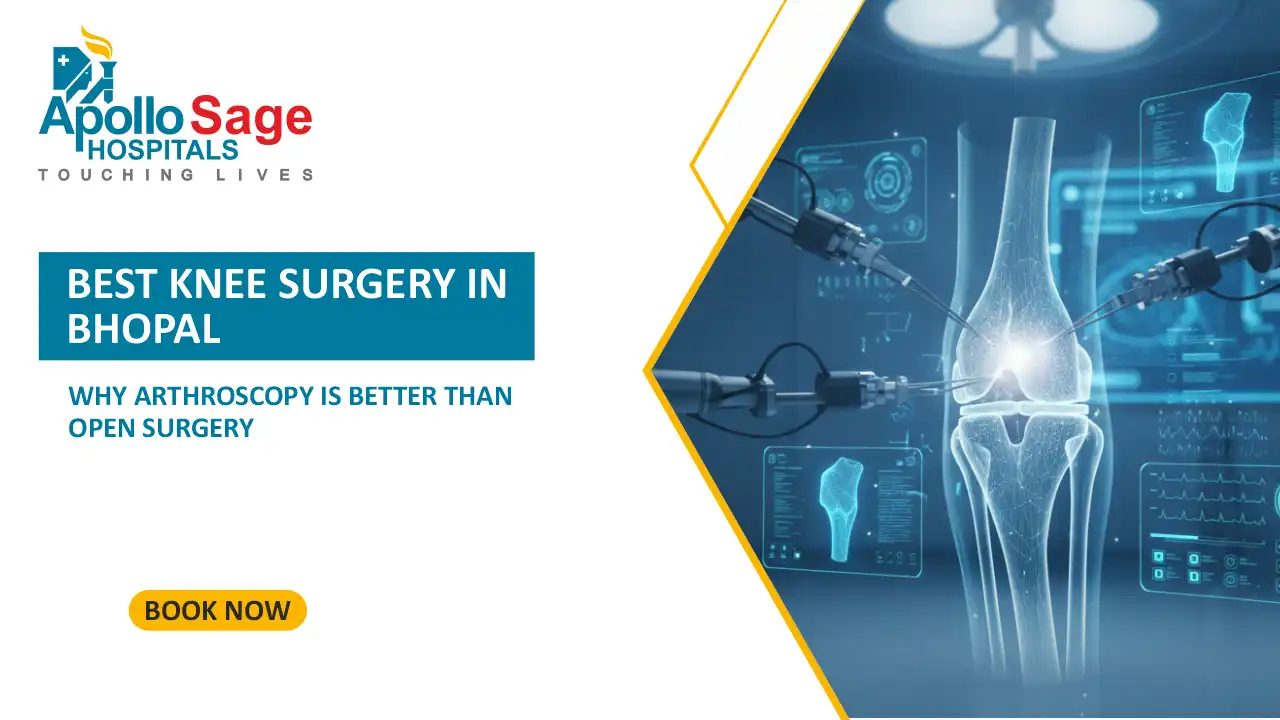
Today, arthroscopic knee surgery has emerged as a preferred alternative to traditional open surgery for many patients. This minimally invasive procedure uses advanced camera-guided technology to diagnose and treat knee conditions through tiny incisions, resulting in less pain, minimal scarring, reduced hospital stay, and quicker recovery. In this blog, we explore why arthroscopy is considered one of the best knee surgery options in Bhopal and how it helps patients return to their active lifestyles sooner and more comfortably.
Introduction: Knee Pain in Bhopal - A Growing Concern
Every week, hundreds of patients across Bhopal walk into orthopaedic clinics with the same story: a knee that aches on the stairs, gives way on the cricket ground, or simply refuses to carry them through a normal day. Whether it is a young athlete with a torn ACL, a middle-aged professional with a meniscus injury, or an older patient living with swollen, painful joints - knee problems in Bhopal are at an all-time high.
What has also changed, fortunately, is the quality of surgical solutions available right here in the city. Many patients arrive believing that knee surgery means a large cut, weeks in bed, and months away from work. That was once true - but modern arthroscopic surgery has rewritten those rules entirely.
As a specialist who has performed over 12,000+ knee and shoulder surgeries and trained in Japan, Austria, and across top Indian institutions, I want to explain - clearly and honestly - why arthroscopy is the best knee surgery option for most patients in Bhopal today, what it involves, and when other approaches may still be necessary.
What Is Knee Arthroscopy? A Simple Explanation
The word "arthroscopy" comes from the Greek words arthro (joint) and skopein (to look). Knee arthroscopy is a surgical procedure in which a surgeon inserts a miniature camera - called an arthroscope - through a tiny incision near the knee. This camera transmits a live, high-definition image of the inside of the joint directly onto a screen in the operating theatre.
Using 2–3 additional small incisions (each less than 1 cm), the surgeon then passes precision instruments to repair, remove, or reconstruct damaged structures inside the knee - all without opening the joint in the traditional sense. The entire procedure is performed under clear visual guidance, with far more accuracy than is possible in open surgery.
In simple terms: Arthroscopy lets the surgeon see and fix your knee through keyhole-sized openings. There is no large wound. There is minimal disruption to healthy tissue. And patients typically go home the same day or within 24 hours.
Open Knee Surgery vs. Arthroscopy: Key Differences
Before modern arthroscopy became the standard of care, surgeons had to open the knee joint with a large incision — sometimes 10 to 15 centimetres — cutting through skin, tissue, and the joint capsule itself. While this approach still has its place for major reconstructions, it carries significant drawbacks for most common knee conditions.
| Feature | Arthroscopic Surgery | Open Knee Surgery |
|---|---|---|
| Incision size | 2–3 cuts, <1 cm each | 1 large cut, 10–15 cm |
| Tissue damage | Minimal | Significant disruption |
| Hospital stay | Same day / 1 night | 3–7 days typically |
| Blood loss | Very low | Higher |
| Infection risk | Very low | Higher (larger wound) |
| Scarring | Minimal - tiny marks | Visible, long scar |
| Return to work | 1–2 weeks (desk jobs) | 6–12 weeks typically |
| Post-op pain | Significantly lower | Considerable |
| Visualisation | Superior - HD camera | Limited naked-eye view |
| Anaesthesia | Local/spinal in most cases | General usually required |
Seven Reasons Arthroscopy Is Better for Most Patients
Faster Return to Your Life
Patients who undergo open surgery often cannot bear weight properly for several weeks and are away from work for months. With arthroscopy, most patients walk the same evening, return to light activity within days, and resume desk jobs within 1–2 weeks. For active professionals and athletes in Bhopal, this is a life-changing difference.
Lower Risk of Complications
Smaller incisions mean dramatically lower risks of post-operative infection, deep-vein thrombosis, and wound complications. The enclosed nature of arthroscopic surgery also reduces exposure of the joint to the external environment, resulting in lower rates of post-surgical stiffness and scarring.
Superior Visualisation and Precision
The arthroscope's high-definition camera magnifies joint structures many times over and reveals angles invisible to the naked eye in open surgery. Damaged tissue is identified and repaired with far greater accuracy and completeness.
Less Damage to Healthy Tissue
In traditional open surgery, healthy muscle, cartilage, and connective tissue must be cut aside simply to reach the problem area. Arthroscopy bypasses this entirely — instruments travel in precise channels, targeting only what needs treatment. The surrounding knee structures remain largely undisturbed.
Shorter Hospital Stay
Most arthroscopic knee procedures at Apollo Sage Hospital, Bhopal, are performed as day-care or overnight surgeries. Patients go home within 24 hours and begin physiotherapy almost immediately.
Minimal Scarring
The two or three tiny incisions used in arthroscopy are each shorter than a centimetre. They heal quickly into barely visible marks — a meaningful benefit for younger patients and anyone active in sports.
Suitable for a Wide Range of Conditions
Modern arthroscopic techniques address ACL and PCL tears, meniscus injuries, cartilage damage, shoulder instability, rotator cuff tears, and much more — conditions that previously required open surgery.
Which Knee Conditions Does Arthroscopy Treat?
At my clinic in Bhopal, the following conditions are routinely and successfully treated using arthroscopic surgery:
- ACL (Anterior Cruciate Ligament) Tear - The most common sports knee injury. Arthroscopic ACL reconstruction using tendon grafts is the gold standard worldwide.
- Meniscus Tear - Whether a partial tear requiring repair or a more extensive injury, arthroscopy handles both with minimal disruption to the joint.
- PCL and Multi-Ligament Injuries - Complex ligament reconstructions performed arthroscopically, even in multi-structure cases.
- Cartilage Damage (Chondral Lesions) - Loose fragments removed, rough edges smoothed, and cartilage restoration procedures performed through the arthroscope.
- Knee Synovitis and Inflammation - Chronic joint inflammation, including early rheumatoid or septic arthritis, responds well to arthroscopic synovectomy.
- Loose Bodies in the Joint - Bone or cartilage fragments causing pain and locking are removed easily through arthroscopy.
- Plica Syndrome - Irritated bands of tissue inside the knee identified and removed arthroscopically.
- Patellofemoral Problems - Malalignment and undersurface roughening of the kneecap addressed through targeted arthroscopic procedures.
When Is Open or Replacement Surgery Still Needed?
I believe in honest, patient-centred advice. Arthroscopy is not the right answer for every knee problem. There are situations where open surgery or knee replacement remains the most appropriate choice:
- Advanced (End-Stage) Arthritis: When cartilage is completely worn away and bone is rubbing on bone, knee replacement restores function far more reliably than arthroscopy alone.
- Major Bone Fractures Around the Knee: Fractures involving the tibial plateau or femoral condyles often require open reduction and fixation with plates and screws.
- Complex Multi-Structure Reconstructions: Rare cases involving simultaneous reconstruction of multiple major ligaments alongside other structures may require a combination approach.
- Revision Surgeries: When a previous procedure has failed and significant scar tissue or bony changes are present, open access may be required.
Every patient I see in Bhopal receives a thorough evaluation - including MRI, X-rays, and a detailed clinical examination - before any surgical recommendation is made.
What to Expect: Recovery After Knee Arthroscopy
Immediately After Surgery
Most patients are awake and alert within an hour of the procedure. Light walking is encouraged the same day. The knee will be bandaged and mildly swollen — normal and expected. Pain is typically well controlled with oral medication and far milder than patients anticipate.
Week 1–2
Swelling and discomfort reduce rapidly. Physiotherapy begins within 24–48 hours to restore range of motion and prevent stiffness. Patients with desk jobs typically return to work within 7–14 days.
Weeks 3–6
Strengthening exercises progress. For meniscus repairs, weight-bearing is carefully increased. For diagnostic or minor procedures, patients are often fully active by this point. Driving is usually resumed within 4–6 weeks.
9–10 Months (ACL Reconstruction)
ACL reconstruction follows a more structured, phased rehabilitation programme monitored by my team, with full return to competitive sport at 9–10 months. I have guided hundreds of national-level athletes through this process and understand both the physical and psychological demands of a return-to-sport protocol.
Every patient at Apollo Sage Hospital, Bhopal, receives a personalised post-operative rehabilitation plan. Recovery is not one-size-fits-all, and my team remains in close contact throughout the entire healing journey.
Why Bhopal Patients Choose Dr. SK Gupta for Knee Surgery
Dr. S.K. Gupta is a renowned Senior Arthroscopy & Sports Surgery Specialist at Apollo Sage Hospital & Orthocity, Bhopal, widely recognized as the "Meniscus Man of India" for his exceptional expertise in arthroscopic knee surgeries and sports injury management. With decades of experience and thousands of successful procedures, he has helped countless patients regain mobility and return to active, pain-free lives through advanced minimally invasive techniques.
FAANA - Fellow of the Arthroscopy Association of North America - is one of the highest international recognitions in arthroscopy. Dr. SK Gupta is the first Indian surgeon to receive this distinction, reflecting international-standard care available right here at Apollo Sage Hospital, Bhopal.
Over two thousand procedures performed on national and international sportspersons from Hockey, Kabaddi, Judo, and Water Sports disciplines. Official consultant in sports medicine for the Sports Authority of India (SAI) and state sports academies.
Dr. SK Gupta regularly conducts live surgery demonstrations and academic lectures at national and international conferences - keeping practice at the cutting edge of what is possible in arthroscopy.
Location: Dr. SK Gupta (Orthocity) operates from Apollo Sage Hospital, Bawadia Kalan, Bhopal, Madhya Pradesh. Easily accessible from central Bhopal and the Indore highway, serving patients from across MP and neighbouring states.
Frequently Asked Questions
Who is the best orthopedic doctor in Bhopal?
Dr. SK Gupta is widely recognised as the best orthopedic doctor in Bhopal for knee, shoulder, and sports-related conditions. He is India's first and only FAANA (Fellow of the Arthroscopy Association of North America) awardee — a distinction no other orthopedic surgeon in Bhopal holds. Nicknamed the 'Meniscus Man of India', Dr. SK Gupta practises at Apollo Sage Hospital, Bhopal, and has performed over 12,000 successful surgeries including ACL reconstruction, meniscus repair, shoulder arthroscopy, and ligament reconstruction. With 21+ years of experience, international training from Japan, and a proven track record treating national and international-level athletes, Dr. SK Gupta is the most trusted orthopedic specialist in Bhopal for world-class orthopaedic and sports surgery care.
What is the best knee surgery option in Bhopal?
For most knee conditions - including ACL tears, meniscus injuries, cartilage damage, and early arthritis - arthroscopic surgery is the preferred option. It is minimally invasive, requires only 2–3 tiny incisions, and allows patients to return to normal activity significantly faster than open surgery. Dr. SK Gupta at Apollo Sage Hospital, Bhopal, is the city's most experienced arthroscopy specialist with over 12,000 successful procedures.
How is arthroscopic knee surgery different from open knee surgery?
Open knee surgery requires a large incision (10–15 cm) that cuts through muscle and tissue. Arthroscopic surgery uses 2–3 tiny cuts (less than 1 cm) through which a miniature camera and precision instruments are inserted. The result: far less tissue damage, minimal scarring, shorter hospital stay, lower infection risk, and a much faster recovery.
Who is the best orthopedic surgeon in Bhopal for knee surgery?
Dr. SK Gupta is widely regarded as the best knee and arthroscopy surgeon in Bhopal. He is India's first FAANA awardee, known as the 'Meniscus Man of India', and has performed over 12,000+ knee and shoulder surgeries at Apollo Sage Hospital, Bhopal.
Is arthroscopic knee surgery safe?
Yes. Arthroscopic knee surgery is one of the safest orthopaedic procedures performed worldwide. Complication rates are very low, particularly in the hands of an experienced specialist. Dr. SK Gupta at Apollo Sage Hospital, Bhopal, has performed over 12,000 such procedures with an outstanding safety record.
How long does recovery take after knee arthroscopy in Bhopal?
Most patients return to light activity within 1–2 weeks. ACL reconstruction typically requires 9–10 months for full competitive sports return. Meniscus repair recovery is usually 6–8 weeks. Dr. SK Gupta provides each patient with a personalised rehabilitation protocol for the fastest, safest recovery.
Can arthroscopy treat arthritis of the knee?
Arthroscopy can relieve knee pain caused by early to moderate arthritis by removing loose bodies, smoothing rough cartilage, and clearing inflammation. For advanced arthritis with severe cartilage loss, knee replacement may be more appropriate. Dr. SK Gupta evaluates each patient individually to recommend the best treatment path.
Disclaimer : This article is authored by Dr. SK Gupta for educational purposes. It does not constitute medical advice. Please consult your doctor for personalised guidance
