




WHEN FIXING THE FRACTURE WASNT ENOUGH THE SHOULDER THAT LEARNED TO MOVE AGAIN
When Fixing the Fracture Wasn't Enough: The Shoulder That Learned to Move Again
There's a particular kind of satisfaction in solving the problem a patient actually has — not just the one that shows up first on the X-ray.
That's exactly what happened with a 68-year-old gentleman who walked into our ER at Apollo Sage Hospitals after a road traffic accident, clutching his left shoulder in pain no one could ignore.
The Obvious Problem — and the One Hiding Behind It
At first glance, this looked like a straightforward trauma case. History, examination, and X-rays confirmed a fracture in the shoulder. Standard protocol would have been to fix it, splint the recovery, and send him home with a plan to "watch and wait."
But something didn't sit right. The X-rays hinted at more than fresh trauma — there were signs of long-standing wear that predated the accident entirely.
So we dug deeper.
What the MRI and CT Actually Revealed
Further imaging told a more complicated story. This wasn't just a fracture. It was:
- Rotator Cuff Arthropathy — long-term joint damage from a torn, non-functioning rotator cuff
- Significant Cuff Atrophy — the muscles that should stabilize the shoulder had wasted away
- Osteoporotic Bone — bone fragile enough to complicate any standard fixation
Individually, each of these findings would demand caution. Together, they completely changed the treatment calculus.
The Fork in the Road
Here's the dilemma every surgeon eventually faces: treat the symptom in front of you, or treat the whole problem.
If we had simply fixed the fracture — the "safe," expected choice — we would have been patching over a shoulder joint that was already failing. Osteoporotic bone doesn't hold hardware well. A cuff that's atrophied doesn't recover function just because a fracture has healed. And pre-existing arthritis doesn't pause politely while a fracture mends.
The honest projection: fracture fixation now, followed by worsening stiffness and pain, followed eventually by a second, more complicated surgery later — likely under tougher circumstances, with an older patient and a more compromised joint.
We didn't want to hand him that future.
One Definitive Procedure, Instead of Two
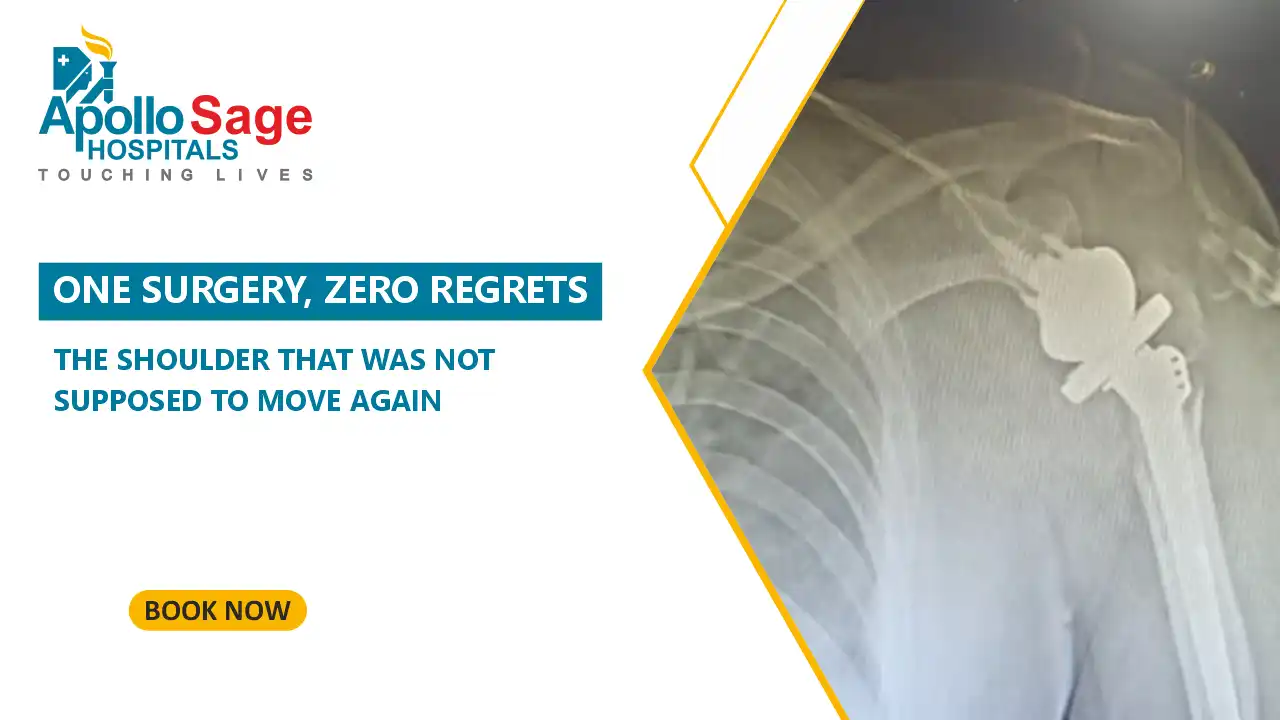
Instead of fixing the fracture and hoping the arthritis would behave, our team chose to address the root problem directly: Reverse Shoulder Arthroplasty.
This approach let us bypass the entire cascade of fracture-healing complications, rebuild a shoulder that could actually move without pain, and remove the looming risk of a future arthritis-driven failure — all in a single, definitive operation.
It's a more technically demanding path. It asks more of the surgical team, the planning, and the execution. But it's also the difference between treating an X-ray and treating a person.
The Team Behind the Outcome
Complex cases like this aren't won by any one person in the operating room. This surgery came together through the combined expertise of Dr. Tejaswini, Dr. Shikha, and Mr. Shailendra, backed by a supporting staff that handled every detail with the seriousness it deserved.
The surgery went smoothly. Recovery has followed the same pattern.
The Moment That Stayed With Us
Medicine doesn't often hand you a moment to remember. This one did.
At his follow-up visit, our patient didn't just say thank you — he arrived with a framed testimonial of gratitude, a gesture that said more than any clinical outcome measure could.
The Real Takeaway
The lesson here isn't really about shoulders. It's about how easy it is to solve the problem that's easiest to see, and how much better outcomes get when you're willing to look past it.
One surgery. Zero regrets. A shoulder that moves again — because someone was willing to think beyond the fracture.
Dr. Yugal Varandani
MBBS,DNB Ortho, MNAMS, FASM, FIJR Arthroscopy & Sports Medicine, Robotic Joint Replacement & Joint Preservation
