




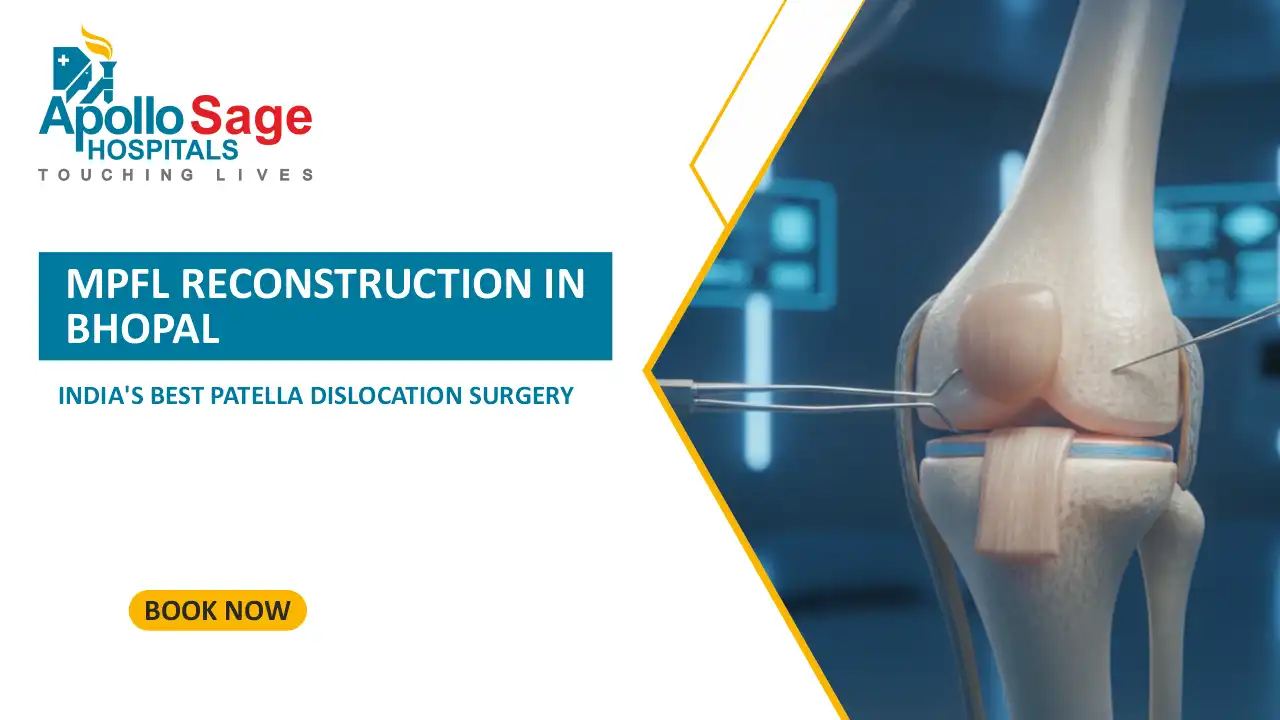
MPFL RECONSTRUCTION IN BHOPAL INDIAS BEST PATELLA DISLOCATION SURGERY
MPFL Reconstruction in Bhopal : India's Best Patella Dislocation Surgery
Every year, tens of thousands of Indians - young athletes, active professionals, and teenagers - experience the terrifying moment when their kneecap slides out of place. A patella dislocation in Bhopal, Delhi, Mumbai, or any corner of the country is not merely a painful injury; left inadequately treated, it becomes a cycle of recurrence that erodes cartilage, confidence, and quality of life.
The gold-standard solution - MPFL reconstruction surgery - is now available at its finest in Bhopal, Madhya Pradesh. At Apollo Sage Hospital, Bhopal, under the leadership of Dr SK Gupta - India's first and only FAANA (Fellow of the Arthroscopy Association of North America) awarded surgeon - patients from across India and abroad receive world-class arthroscopic knee stabilisation with outcomes that benchmark against the finest international centres.
What Is Patella Dislocation? The Anatomy of a Knee Crisis
The patella (kneecap) sits in the trochlear groove at the lower end of the femur and glides smoothly during knee movement. A patellar dislocation occurs when a sudden twist, direct blow, or abnormal biomechanics forces the kneecap outward out of this groove. The result is a pop, immediate severe pain, visible deformity, and rapid swelling (haemarthrosis) from blood entering the joint.
While a single episode can sometimes be managed conservatively, up to 40% of patients experience recurrent patellar instability - repeated dislocations that progressively destroy articular cartilage. Once instability becomes recurrent, surgery is the only definitive solution.
Understanding the MPFL - The Kneecap's Critical Seat Belt
The Medial Patellofemoral Ligament (MPFL) runs from the medial border of the patella to the medial femoral epicondyle, providing approximately 50-60% of the total restraining force that keeps the kneecap from slipping sideways. The MPFL tears in virtually 100% of patella dislocations.
When the torn MPFL heals poorly - or when anatomical predispositions such as a shallow trochlear groove, high-riding kneecap (patella alta), or excessive tibial tubercle lateralisation are present - the patella re-dislocates with progressively lower force thresholds. Each recurrence inflicts further cartilage damage and raises the risk of early patellofemoral arthritis.
Symptoms, Risk Factors & When Surgery Is Necessary
Recognising Patella Dislocation Symptoms
- Sudden, severe pain at the front or inner side of the knee
- Visible kneecap deformity - shifted outward, knee looks deformed
- Immediate swelling (haemarthrosis) within hours of injury
- Inability to straighten the leg or bear weight
- Persistent giving-way sensation - the knee buckles during daily activities
- Apprehension sign - guarding when the knee nears the dislocation position
- Clicking or grinding (crepitus) - indicates articular cartilage damage
Risk Factors for Recurrent Patellar Instability
| Risk Factor | Clinical Significance |
|---|---|
| Trochlear dysplasia | Shallow femoral groove - #1 bony risk factor |
| Elevated TT-TG (>20 mm) | Lateral pull on patella increases dislocation risk |
| Patella alta | High-riding kneecap - less trochlear groove engagement |
| Ligamentous laxity | Common in young women; multi-directional instability |
| Previous dislocation | 30-40% recurrence risk; higher with bony factors |
| High-impact sport | Football, basketball, dance, gymnastics - pivoting loads |
When Is MPFL Reconstruction Surgery Recommended?
- Two or more episodes of patellar dislocation
- First dislocation with trochlear dysplasia, patella alta, or TT-TG >20 mm
- Significant articular cartilage damage identified on MRI
- Young athletes who cannot accept any further dislocation risk
- Conservative management for 3+ months has failed to restore stability
Why Apollo Sage Hospital, Bhopal Is India's Finest Arthroscopy Centre
Apollo Sage Hospital, Bhopal is the only Centre of Excellence for Sports Surgeries in Central India, recognised by the Abhinav Bindra Foundation Trust. This recognition reflects stringent standards in surgical outcomes, rehabilitation infrastructure, and patient care. Under Dr SK Gupta's leadership, the hospital has become a national reference centre for arthroscopic knee surgery.
- 4K HD Arthroscopy Suite with radiofrequency ablation and international-grade implants
- Dedicated Sports Rehabilitation Unit - structured physio protocols for faster, safer recovery
- NABH Accreditation and Apollo Healthcare infection control standards
- Pan-India Teleconsultation with home-city rehabilitation protocol handover
- Location: Bhopal (Raja Bhoj Airport) - direct flights from Delhi, Mumbai, Bangalore, Hyderabad
Patients travelling from outside Madhya Pradesh benefit from Apollo Sage's experienced outstation coordination team. Bhopal's connectivity and the hospital's comprehensive care make it the most accessible choice for the best MPFL surgery in India.
Dr SK Gupta: India's Most Trusted MPFL Reconstruction Surgeon
When patients search for the best MPFL surgeon in India, one name consistently rises to the top - Dr. Sheetal Kumar Gupta (Dr SK Gupta), Director of Arthroscopy & Joint Replacement at Apollo Sage Hospital, Bhopal, with 21+ years of experience and 12,000+ surgeries performed.
Dr Gupta customises every surgical plan: isolated MPFL reconstruction for soft-tissue instability; MPFL + tibial tubercle osteotomy (Fulkerson) for elevated TT-TG; MPFL + trochleoplasty for severe trochlear dysplasia; simultaneous cartilage restoration when arthroscopy reveals articular damage. Revision reconstructions are also performed for patients who have failed surgery elsewhere.
With 21+ years and 12,000+ surgeries, his complication rates are consistently below international benchmarks. Patient satisfaction scores rank among the highest in India.
The MPFL Reconstruction Procedure: Step by Step
Pre-operative assessment includes standing X-rays, MRI, and CT scan for precise TT-TG distance measurement. This data drives every surgical decision.
- Step 1 - Diagnostic Arthroscopy: Camera introduced through 5 mm portals to assess cartilage, confirm MPFL tear, and evaluate patellar tracking.
- Step 2 - Graft Harvest: The gracilis tendon is harvested through a 2 cm incision and prepared to become the new MPFL.
- Step 3 - Femoral Tunnel Preparation: Under fluoroscopic guidance, a tunnel is drilled at the precise isometric point on the medial femoral epicondyle.
- Step 4 - Patellar Fixation: Graft secured to the medial patella using suture anchors at the native MPFL footprint.
- Step 5 - Graft Tensioning: Tensioned at 30 degrees of knee flexion - neither too tight nor too loose - then fixed with an interference screw.
- Step 6 - Bony Correction (if needed): Tibial tubercle osteotomy or trochleoplasty performed in the same sitting when anatomical correction is required.
Most patients are discharged from Apollo Sage Hospital, Bhopal within 24-48 hours. Physiotherapy begins on Day 1 with gentle quad sets and ankle pumps.
Recovery Roadmap & Return to Sport
| Phase | Timeline | Key Goals |
|---|---|---|
| Immediate Post-Op | Day 0-2 | Discharge; brace locked; crutches; ice & elevation |
| Early Mobilisation | Week 1-6 | Gradual ROM 0-90 degrees; quad activation; swelling control |
| Strengthening | Week 6-16 | Progressive quad/VMO; cycling; full weight-bearing |
| Functional Phase | Month 4-6 | Jogging; agility drills; proprioception training |
| Return to Sport | Month 6-9 | Clearance after hop tests and strength symmetry >90% |
Graft ligamentisation - the biological process by which the tendon graft remodels into true ligament tissue - takes 6-9 months. Dr Gupta's team uses objective functional testing (hop tests, isokinetic strength symmetry >90%) before clearing any patient for competitive sport.
Patient Reviews & Success Stories
I had dislocated my kneecap four times in two years - each time more painful than the last. After MPFL reconstruction with Dr SK Gupta at Apollo Sage Bhopal, I played my first competitive football match eight months later. He gave me my life back.
★★★★★ Rahul M., 24 | Football Player, Indore
Dr Gupta took the time to explain everything - why my kneecap kept dislocating, exactly what the surgery would do, and what recovery would involve. The surgery was smooth, and I am back to my gym routine at 5 months.
★★★★★ Priya S., 31 | Fitness Professional, Bhopal
I travelled from Hyderabad to Bhopal specifically for Dr SK Gupta after reading about his FAANA recognition. Everything was meticulously organised. Completely world-class experience.
★★★★★ Anil K., 27 | Software Engineer & Cricket Player, Hyderabad
Frequently Asked Questions - People Also Ask
What is MPFL reconstruction and who needs it in Bhopal?
MPFL reconstruction is a minimally invasive arthroscopic surgery rebuilding the torn ligament that keeps the kneecap in its groove. At Apollo Sage Hospital Bhopal, Dr SK Gupta recommends it for patients with two or more patella dislocations, or a first dislocation with bony risk factors like trochlear dysplasia, elevated TT-TG (>20 mm), or patella alta.
How long does MPFL reconstruction recovery take in India?
Most patients walk on crutches from Day 1 and achieve full knee range of motion by 6-8 weeks. Return to recreational activities occurs at 4-6 months; competitive sport clearance is typically at 6-9 months following Dr SK Gupta's structured rehabilitation protocol at Apollo Sage Bhopal.
Is Dr SK Gupta the best MPFL surgeon in India?
Dr SK Gupta is India's first and only FAANA-awarded arthroscopy surgeon. With 21+ years, 12,000+ surgeries, fellowships in Japan, Singapore, and Delhi, and Abhinav Bindra Foundation Trust recognition, he is among India's most accomplished MPFL reconstruction surgeons.
Why choose Apollo Sage Hospital Bhopal for patella dislocation surgery?
Apollo Sage Hospital Bhopal is the only Centre of Excellence for Sports Surgeries in Central India (Abhinav Bindra Foundation Trust). It offers 4K HD arthroscopy, international-grade implants, and a dedicated sports rehab unit. Patients from Delhi, Mumbai, Hyderabad, and Bangalore travel here for Dr SK Gupta's care.
What is the difference between MPFL repair and MPFL reconstruction?
MPFL repair (direct stitching) suits only first-time dislocations with clean bone avulsion and no bony risk factors. MPFL reconstruction - Dr Gupta's standard approach - uses a tendon graft to build a new anatomically placed ligament with superior durability.
Can I travel from Delhi, Mumbai, or Hyderabad to Bhopal for MPFL surgery?
Yes. Bhopal (Raja Bhoj Airport) has direct flights from all major Indian metros. Dr SK Gupta's team offers teleconsultation and a complete rehabilitation protocol handover for patients completing recovery in their home city.
How many patella dislocation surgeries has Dr SK Gupta performed?
Dr SK Gupta has performed over 12,000+ surgeries in 21+ years. His case volume for complex knee instability - including MPFL reconstruction, combined bony corrections, and revision surgeries - is among the highest in Central and North India.
Ready to Regain a Stable, Pain-Free Knee?
Book your consultation with - Apollo Sage Hospital, Bhopal. Patients from all over India welcome.
ABOUT THE AUTHOR
Dr. S.K. Gupta is a Senior Orthopaedic, Knee & Shoulder Joint Surgeon at Apollo Sage Hospital, Bhopal, with 21+ years of experience and 12,000+ surgeries performed. He holds an MS in Orthopaedics (Mumbai) and international fellowships from Japan, Singapore, and Delhi. Widely known as the Meniscus Man of India, he is the first arthroscopy surgeon from India to receive the prestigious FAANA Fellowship and is recognised by the Abhinav Bindra Foundation Trust as a Centre of Excellence for Sports Surgeries.
Medical Disclaimer: This article is for informational and educational purposes only and does not constitute personalised medical advice.
