




MENISCUS TEAR TREATMENT IN BHOPAL
Meniscus Tear Treatment in Bhopal: When to Choose Arthroscopy vs When to Avoid Surgery
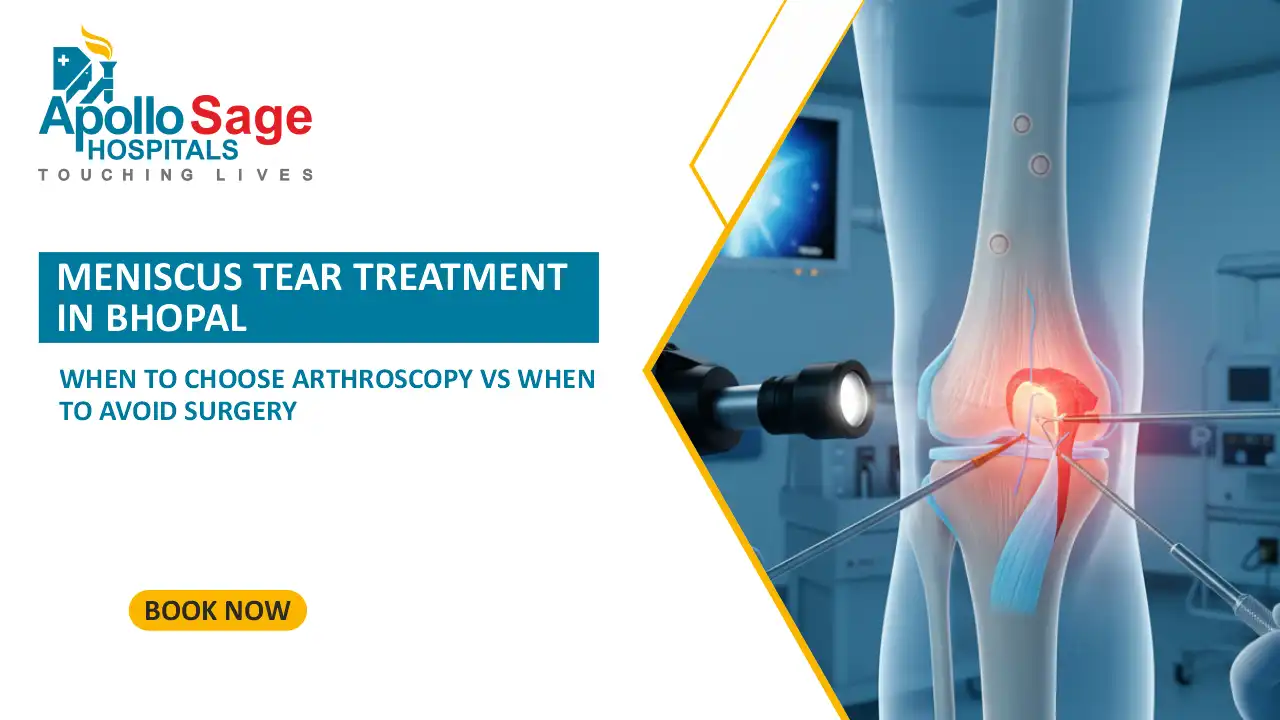
If you have been diagnosed with a meniscus tear in Bhopal and are wondering whether you need surgery, you are not alone. Thousands of patients visit Dr SK Gupta at Apollo Sage Hospital, Bhopal, each year asking exactly this question. The good news: not every meniscus tear requires the operating room. In this guide, Dr SK Gupta - widely known as the Meniscus Man of India - shares the clinical framework he uses to decide when knee arthroscopy in Bhopal is essential and when conservative care is the smarter path.
What Is the Meniscus and Why Does It Tear?
The meniscus is a pair of C-shaped cartilage discs - medial (inner) and lateral (outer) - that sit between the thigh bone (femur) and shin bone (tibia) in each knee. Think of them as the knee's shock absorbers and stabilisers, distributing up to 70% of the load passing through the joint with every step.
- Traumatic tears happen suddenly - a twist during cricket, a football tackle, a slip on a wet floor, or a fall from a bike. Young athletes in Bhopal aged 15–35 are most vulnerable.
- Degenerative tears develop gradually as the meniscus weakens with age. In patients over 45 in Bhopal, even routine activities like squatting or climbing stairs can cause a partial tear.
Dr SK Gupta's Insight: "The biggest mistake patients make is assuming every torn meniscus needs surgery. The anatomy of the tear, the patient's age, activity level, and knee stability are what drive my decision - not the MRI report alone."
Types of Meniscus Tears — Which Ones Need Surgery?
Understanding the tear pattern is the first step in deciding between meniscus surgery in Bhopal and conservative management.
By Blood Supply Zone
The red-red zone (outer 25%) heals well without surgery. The red-white zone (middle third) may heal with surgical repair. The white-white zone (inner third) is avascular - tears here rarely heal without partial meniscectomy.
By Tear Pattern
Longitudinal tears in the outer zone are the best candidates for preservation. Bucket-handle tears almost always require urgent knee arthroscopy in Bhopal. Radial and complex inner-zone tears are typically managed with partial removal.
By MRI Grade
Grade I (no surgery needed) · Grade II (conservative care first) · Grade III (full-thickness — arthroscopy often recommended).
When Can You Safely Avoid Meniscus Surgery in Bhopal?
Dr SK Gupta follows an evidence-based protocol and recommends a non-surgical approach when specific criteria are met. Many patients asking "can meniscus tear heal without surgery in Bhopal?" are surprised to learn the answer is often yes.
| Criterion | Non-Surgical | Surgical (Arthroscopy) |
| Tear Zone | Outer (red-red) zone | Inner (white-white) zone |
| Tear Pattern | Small longitudinal, partial | Bucket-handle, complex, radial |
| Knee Stability | Stable, no locking | Locking, instability, giving way |
| Patient Age | Over 50, low-demand | Under 40, active athlete |
| MRI Grade | Grade I or II | Grade III full-thickness |
| Conservative Trial | Not yet tried | Failed after 6–8 weeks |
| Associated Injuries | Isolated meniscus tear | ACL/PCL tear + meniscus tear |
Conservative Meniscus Tear Treatment in Bhopal
Structured 6–8 week protocol: relative rest and activity modification, supervised physiotherapy (quadriceps and hamstring strengthening), anti-inflammatory medication, and intra-articular injections (PRP or hyaluronic acid) where indicated. Most patients see significant improvement in meniscus tear knee pain within four to six weeks.
When to Choose Knee Arthroscopy in Bhopal
When the following red flags are present, arthroscopic meniscus repair in Bhopal should not be postponed.
Mechanical Locking of the Knee
If you cannot fully straighten your knee, a bucket-handle fragment is blocking extension. Every day of delay causes irreversible cartilage damage. Urgent arthroscopy is required.
Giving Way or Severe Instability
A knee that buckles unexpectedly suggests the torn meniscus has compromised joint biomechanics. Surgery restores stability and prevents secondary cartilage damage.
Active Athletes and Young Patients
For a cricketer, footballer, or gym athlete in Bhopal under 40, meniscus preservation surgery is strongly preferred. Losing meniscal tissue accelerates osteoarthritis by 40–60% over 10 years.
Failed Conservative Treatment
If pain and swelling persist after 6–8 weeks of non-surgical management, knee arthroscopy in Bhopal is the next step.
Combined Ligament and Meniscus Injuries
When MRI reveals a combined ACL tear and meniscus tear, both are addressed in the same arthroscopic session, reducing total recovery time.
What Happens During Arthroscopic Meniscus Repair at Apollo Sage Hospital, Bhopal?
Minimally invasive keyhole surgery under spinal or general anaesthesia, typically 45–90 minutes.
Step 1 - Diagnostic Arthroscopy
Two small incisions (portals), each less than 1 cm, are made around the knee. A thin camera is inserted and Dr SK Gupta directly visualises the tear on a HD monitor - more accurate than any MRI.
Step 2 - Tear Assessment
Location, pattern, tissue quality, and stability are probed. Meniscus preservation is always Dr SK Gupta's first goal.
Step 3 - Repair or Resection
For repair, absorbable sutures draw torn edges together. For partial meniscectomy, only the unstable fragment is removed — the healthy rim is preserved. Dr SK Gupta never performs a total meniscectomy.
Step 4 - Biologic Enhancement
PRP or fibrin clot is introduced at the repair site where appropriate, significantly improving healing outcomes at Apollo Sage Hospital, Bhopal.
Most patients are discharged within 24 hours and begin physiotherapy within 48 hours of their arthroscopic meniscus repair in Bhopal.
Meniscus Surgery Recovery Time in Bhopal - What to Expect
After Partial Meniscectomy (Removal)
Crutches on day one, discarded by week two. Desk work at 2–3 weeks. Driving at 3–4 weeks. Sports at 6–8 weeks. Faster recovery with a long-term trade-off of slightly more joint wear.
After Meniscus Repair (Suture)
Non-weight-bearing for 2–4 weeks. Return to sports takes 4–6 months. A preserved meniscus protects the joint for decades and significantly delays osteoarthritis.
Physiotherapy - The Key to Full Recovery
Dr SK Gupta works closely with physiotherapy teams at Apollo Sage Hospital and Dr SK Gupta Orthocity, Bhopal. Compliance with physiotherapy is the single biggest predictor of a successful outcome.
Meniscus Preservation Surgery Cost in Bhopal
Meniscus preservation surgery cost in Bhopal is influenced by: the surgical technique (repair vs resection), implants used, anaesthesia type, hospital stay duration, and rehabilitation requirements. At Apollo Sage Hospital, Bhopal, Dr SK Gupta's team provides a transparent cost estimate after consultation and MRI review. Most private health insurance and corporate mediclaim policies cover the procedure.
Why Choose Dr SK Gupta for Meniscus Tear Treatment in Bhopal?
Patients searching for the best meniscus surgeon in Bhopal consistently arrive at the same name: Dr SK Gupta.
The Meniscus Man of India
Dr SK Gupta earned this title through pioneering meniscus preservation work at a time when most Indian surgeons defaulted to total meniscectomy. His advocacy has changed outcomes for thousands of patients from Bhopal, Indore, Jabalpur, and beyond.
21+ Years of Subspecialty Experience
MS in Orthopaedics (Mumbai) and international arthroscopy fellowships from Japan, Singapore, and Delhi. Over 12,000 surgeries benchmarked against international standards.
First Indian Arthroscopy Surgeon — FAANA Fellowship
Dr SK Gupta is the first arthroscopy surgeon from India to receive the prestigious FAANA Fellowship (Fellow of the Arthroscopy Association of North America) — the highest recognition in the field globally.
Recognised Centre of Excellence
The Abhinav Bindra Foundation Trust recognises Dr SK Gupta's practice as a Centre of Excellence for Sports Surgeries — the same foundation that supports India's Olympic athletes.
Frequently Asked Questions - Meniscus Tear Treatment in Bhopal
Structured for Google's People Also Ask boxes and voice search.
Can a meniscus tear heal without surgery in Bhopal?
Yes - small tears in the outer red-red zone often heal with physiotherapy, rest, and anti-inflammatory treatment over 6–8 weeks. Dr SK Gupta at Apollo Sage Hospital, Bhopal, evaluates each case individually before recommending surgery. Many patients avoid the operation entirely with the right conservative protocol.
What is the recovery time after meniscus surgery in Bhopal?
After partial meniscectomy: daily activities in 2–3 weeks, sports in 6–8 weeks. After meniscus repair: full recovery and sports return takes 4–6 months. Dr SK Gupta provides a personalised rehabilitation plan for every patient at Apollo Sage Hospital and Orthocity, Bhopal.
What is the cost of meniscus preservation surgery in Bhopal?
Cost varies based on technique (repair vs resection), implants, hospital stay, and rehabilitation. Apollo Sage Hospital provides transparent pre-surgery estimates. Most insurance plans cover the procedure. Call +91-9303972510 for a detailed quote.
Who is the best meniscus surgeon in Bhopal?
Dr SK Gupta - the Meniscus Man of India. 12,000+ surgeries, 21+ years of experience, first Indian to receive the FAANA Fellowship, practicing at Apollo Sage Hospital and Orthocity, Bhopal.
When is knee arthroscopy in Bhopal necessary for a meniscus tear?
When: conservative treatment fails after 6–8 weeks; the knee locks or cannot be fully straightened; there is significant instability; the patient is a young athlete; or the tear is combined with an ACL/PCL injury.
How do I book an appointment with Dr SK Gupta in Bhopal?
Book online at apollosage.in/doctors/dr-s-k-gupta or call +91-9303972510 / +91-0755-4308111.
About the Author - Dr. S.K. Gupta
Dr. S.K. Gupta is a Senior Orthopaedic, Knee & Shoulder Joint Surgeon at Apollo Sage Hospital, Bhopal, with 21+ years of experience and 12,000+ surgeries performed. He holds an MS in Orthopaedics (Mumbai) and international fellowships from Japan, Singapore, and Delhi.
Widely known as the Meniscus Man of India, he is the first arthroscopy surgeon from India to receive the prestigious FAANA Fellowship and is recognised by the Abhinav Bindra Foundation Trust as a Centre of Excellence for Sports Surgeries.
