




MENISCUS SURGERY IN BHOPAL REPAIR PRESERVE AND PROTECT YOUR KNEE
Meniscus Surgery in Bhopal - Repair, Preserve, and Protect Your Knee
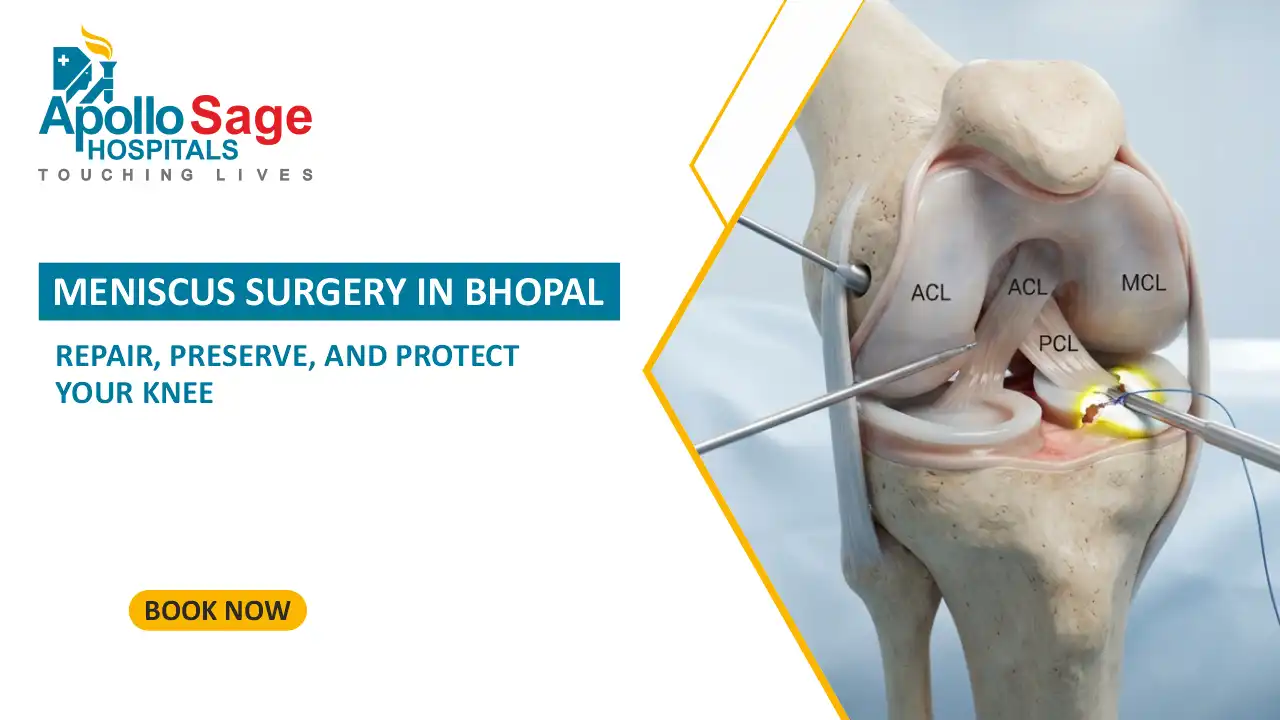
The meniscus is far more than just a cushion. These two C-shaped fibrocartilage structures - the medial and lateral menisci - distribute load, stabilise the knee, and protect the underlying articular cartilage from damage. When they tear, Meniscus Surgery in Bhopal by an arthroscopic specialist can mean the difference between a repaired, preserved knee that lasts decades and premature joint degeneration that leads to early arthritis. If you have been told you have a meniscal tear, the most important thing you can do is see an experienced Meniscus Surgeon in Bhopal.
Types of Meniscal Tears and What They Mean for Treatment
Not all meniscal tears are the same. The type, location, and pattern of the tear - and whether it is in the vascular 'red zone' (where blood supply supports healing) or the avascular 'white zone' - determines whether repair or trimming is the appropriate treatment.
- Vertical/longitudinal tear: Most common in younger patients following sports injury. Often repairable, especially in the red zone.
- Bucket-handle tear: A large vertical tear that flips into the joint. Causes locking. Requires urgent arthroscopic intervention.
- Radial tear: Cuts across the circumferential fibres. Disrupts the meniscus's load-distribution function. May need partial trimming.
- Horizontal/degenerative tear: Common in older patients. Often associated with arthritic changes. Conservative management may work first.
- Complex tear: Involves multiple planes. Usually requires partial or subtotal meniscectomy.
Meniscus Repair in Bhopal vs. Meniscectomy - A Critical Decision
Whenever technically feasible, Meniscus Repair in Bhopal is preferred over trimming (meniscectomy). Removing meniscal tissue reduces the knee's shock absorption by 50–70%, significantly increasing the risk of cartilage wear and early osteoarthritis.
Dr. Vivek Tiwari's guiding principle: repair first, remove only what cannot be saved. His arthroscopic repair techniques include inside-out, outside-in, and all-inside suture methods - selected based on tear location, pattern, and tissue quality.
Meniscus Tear Surgery in Bhopal — The Arthroscopic Approach
All Meniscus Tear Surgery in Bhopal is performed arthroscopically through 2–3 small portals — no large incisions. The procedure takes 30–60 minutes under spinal anaesthesia, depending on whether repair or partial meniscectomy is performed and whether concurrent procedures (ACL reconstruction, cartilage treatment) are needed.
Recovery differs significantly depending on the procedure:
- Partial meniscectomy: Weight-bearing from day 1. Return to activities in 4–6 weeks. Faster but less tissue preservation.
- Meniscus repair: Protected weight-bearing for 4–6 weeks. Return to sport at 4–6 months. Slower but preserves the long-term health of the joint.
Knee Cartilage Surgery in Bhopal — When Damage Goes Deeper
Knee Cartilage Surgery in Bhopal is often performed simultaneously with meniscal procedures when cartilage damage is identified at arthroscopy. Techniques include microfracture (stimulating bone marrow healing), OATS (osteochondral autograft transfer), ACI (autologous chondrocyte implantation), and scaffold-based cartilage restoration. Dr. Tiwari's training in cartilage preservation surgery — developed through his international fellowships — enables him to address even complex combined meniscal and cartilage injuries in a single operative setting.
Signs You May Need to See a Meniscus Surgeon in Bhopal
- Knee pain along the inner or outer joint line after a twist or squat
- Swelling that develops over 24–48 hours after injury
- Knee locking — inability to fully straighten the joint (bucket-handle tear until proven otherwise)
- A clicking, catching, or giving-way sensation during movement
- Pain when squatting, pivoting, or climbing stairs
An MRI scan confirms the diagnosis and characterises the tear. Do not delay — untreated meniscal tears can cause progressive cartilage damage that is far more difficult to reverse.
About Dr. Vivek Tiwari — The Surgeon Behind Your Meniscus Surgery
Dr. Vivek Tiwari is a Senior Consultant Orthopaedic, Joint Replacement & Bone Tumour Surgeon at Apollo Sage Hospital, Bhopal, with over 13 years of dedicated experience in orthopaedic surgery. His academic and clinical journey is genuinely global:
- MBBS — Maulana Azad Medical College, New Delhi (AIR 27 in All India Medical Entrance Exam)
- MS Orthopaedics — AIIMS New Delhi (AIR 5 in AIIMS PG Entrance Exam)
- DNB Orthopaedics — National Board of Examinations, 2015
- MRCS — Royal College of Surgeons, Edinburgh, UK
- Fellow in Knee Surgery & Sports Medicine — Seoul National University Bundang Hospital, South Korea, 2017
- SICOT Fellow — Fondazione IRCCS Policlinico San Matteo, Pavia, Italy, 2017
- Fellow in Hip & Knee Arthroplasty & Sports Medicine — Evangelisches Krankenhaus Wien (EKH), Vienna, Austria, 2017
- Robotic Joint Replacement Training — Hospital for Special Surgery (HSS), New York, USA — ranked No. 1 Joint Replacement Hospital in the world for 13 consecutive years
- Bone Tumour Training — Memorial Sloan Kettering Cancer Center (MSKCC), New York, USA
- FIFA Diploma in Football Medicine — certified sports medicine expertise
- Ex-Faculty & Unit Incharge — Department of Orthopaedics, AIIMS Nagpur (2019–2023)
IOA Travelling Fellow | Life Member, Asia Pacific Arthroplasty Society (APAS) | Life Member, ISKSAA
Awards include Best Poster Presentation (IOACON 2014), Gold Medal Session paper presentation (IOACON 2014), Best Orator Trophy at 1st TYSA National Round, and recognition at IPOS 2014, Florida, USA.
Conclusion
Your meniscus is worth saving. With the right arthroscopic technique, Meniscus Surgery in Bhopal can restore full function, protect your cartilage, and delay or prevent arthritis by decades. Dr. Vivek Tiwari - with deep training in arthroscopic sports surgery, Meniscus Repair in Bhopal, and combined cartilage procedures — is the specialist your knee deserves.
Frequently Asked Questions
Q1: Can a torn meniscus heal without surgery?
Ans. : Small tears in the outer (red zone) portion of the meniscus may heal with conservative care — rest, physiotherapy, and a period of protected weight-bearing. However, most symptomatic tears, particularly those causing pain, swelling, or locking, require Meniscus Surgery in Bhopal for reliable resolution.
Q2: How long does meniscus repair surgery take?
Ans. : Arthroscopic Meniscus Tear Surgery in Bhopal takes 30–60 minutes. If combined with ACL reconstruction or cartilage treatment, the operative time is 75–120 minutes. Recovery is longer for repair (4–6 months) than meniscectomy (4–6 weeks).
Q3: Is meniscus repair better than meniscectomy?
Ans. : Yes, in most cases. Meniscus Repair in Bhopal preserves the shock-absorbing function of the joint, reduces long-term arthritis risk, and produces better outcomes over a 10–20-year period. Dr. Vivek Tiwari always prioritises repair over removal when tissue quality and tear location permit.
Q4: How do I know if I need knee cartilage surgery alongside my meniscus repair?
Ans. : Cartilage damage is often only visible at arthroscopy. If MRI suggests chondral lesions alongside a meniscal tear, Knee Cartilage Surgery in Bhopal may be performed simultaneously. Dr. Tiwari reviews each patient's imaging thoroughly and plans combined procedures when needed.
Q5: What is recovery like after meniscectomy vs. meniscus repair?
Ans. : After partial meniscectomy, most patients are walking the same day and back to activities in 4–6 weeks. After Meniscus Repair in Bhopal, a 4–6 week period of protected weight-bearing is required, with return to sport at 4–6 months. The slower recovery is a worthwhile investment in long-term joint health.
