





MECHANICAL THROMBECTOMY SUCCESS TREATING BRAIN STROKE EVEN 24 HOURS AFTER ONSET
Mechanical Thrombectomy Success: Treating Brain Stroke Even 24 Hours After Onset
Most people believe that stroke treatment is only effective within the first few hours of symptom onset — the so-called "golden hour." But what happens when a patient arrives at the hospital nearly a full day after their stroke began? Is recovery still possible?
The answer, as this remarkable case from Apollo Sage Hospitals shows, is yes — thanks to advanced imaging technology and a procedure known as extended-window mechanical thrombectomy.
This is the story of a 62-year-old man from Sagar who regained his speech, his mobility, and his independence, even though he reached the advanced stroke center almost 24 hours after his symptoms first appeared.
The Patient's Journey
The patient, a known diabetic with a prior history of stroke, suddenly experienced two alarming symptoms:
- Severe weakness on the right side of his body
- Complete inability to speak
These are classic warning signs of an acute ischemic stroke, caused by a blockage in the blood supply to the brain.
He was first rushed to a local hospital in Sagar, where doctors acted quickly and administered intravenous thrombolysis — a clot-dissolving medication that is the standard first-line treatment for stroke. However, despite this timely intervention, his neurological symptoms did not improve.
Further evaluation revealed the real culprit: a blockage in the left internal carotid artery (ICA) — one of the major blood vessels responsible for supplying oxygen-rich blood to the brain. Given the severity of the blockage, the patient was referred to a higher-level facility equipped for advanced stroke intervention.
Racing Against Time — Even After Time Had Run Out
By the time the patient arrived at the advanced stroke center, nearly 24 hours had passed since the onset of his symptoms. In conventional stroke treatment protocols, this would typically be considered too late for intervention.
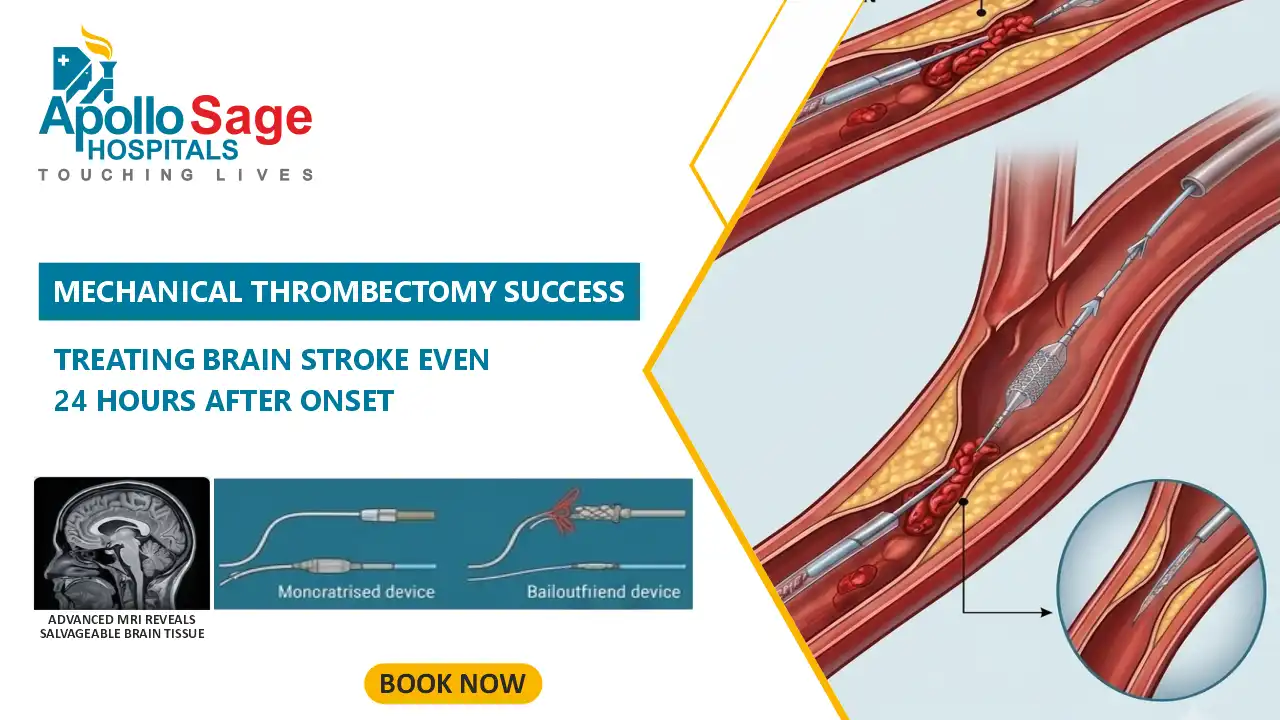
However, the medical team didn't give up. They performed an advanced MRI scan, which revealed something crucial: a significant portion of the patient's brain tissue was still salvageable. This finding made him a candidate for a specialized, cutting-edge procedure — extended-window mechanical thrombectomy.
After counseling the patient's family and explaining the risks and benefits, the neuro-intervention team proceeded with the emergency procedure.
What Is Mechanical Thrombectomy?
Mechanical thrombectomy is a minimally invasive procedure used to physically remove a blood clot from a blocked artery in the brain. Here's how it works:
- Specialized catheters are carefully guided through the patient's blood vessels, starting typically from the groin or wrist, up to the site of the blockage in the brain.
- A clot-retrieval device is deployed at the site of the obstruction.
- The clot is captured and safely removed, restoring normal blood flow.
In this case, the procedure resulted in complete recanalization of the left ICA territory — meaning blood flow to the affected part of the brain was fully restored.
A Remarkable Recovery
The results were nothing short of extraordinary:
- Immediately after the procedure, the patient began speaking again.
- Within a day, his right-sided weakness showed dramatic improvement.
- By the time of discharge, he had regained near-complete strength and full functional independence.
For a patient who arrived nearly 24 hours after stroke onset — a window most people assume is "too late" — this outcome demonstrates just how far modern stroke care has advanced.
Why This Case Matters: The "Extended Window" for Stroke Treatment
Traditionally, stroke treatment guidelines have focused on a narrow time frame after symptom onset. But research and clinical advances have shown that not all brain tissue dies at the same rate — some patients retain salvageable brain tissue well beyond the traditional window.
This is where advanced imaging (like perfusion MRI or CT) plays a game-changing role. It allows doctors to look beyond the clock and assess the actual state of the brain tissue, identifying which patients can still benefit from intervention — even 12, 18, or 24 hours after symptoms begin.
Key takeaways from this case:
- Rapid referral from a local hospital to an advanced stroke center was critical.
- Advanced imaging helped identify salvageable brain tissue despite the delayed presentation.
- Extended-window thrombectomy made a full recovery possible, even outside the traditional treatment timeframe.
Recognizing Stroke Symptoms: Every Minute Counts
While this case shows that treatment can still help beyond the golden hour, early recognition and immediate action remain the best path to full recovery. Remember the acronym BE FAST:
- Balance – Sudden loss of balance or coordination
- Eyes – Sudden vision changes or loss of vision
- Face – Facial drooping on one side
- Arms – Weakness or numbness in one arm
- Speech – Slurred speech or difficulty speaking
- Time – Time to call emergency services immediately
If you or a loved one experience any of these symptoms, don't wait. Seek immediate medical attention — and if possible, head to a hospital equipped with advanced stroke intervention capabilities.
Conclusion
This case is a powerful reminder that stroke care has evolved dramatically. Thanks to advanced imaging and techniques like extended-window mechanical thrombectomy, patients who reach the hospital late no longer have to face the grim outcomes once considered inevitable.
For this 62-year-old patient from Sagar, what could have been a life-altering disability turned into a genuine second chance at life — a testament to the power of timely referral, cutting-edge technology, and skilled medical intervention.
When every second counts in a stroke emergency, Dr. Justin Thomas is the name Bhopal turns to. A pioneer who launched the city's first-ever thrombectomy program, he has performed 500+ life-saving neurointerventions, giving countless patients a genuine second chance at life.
Trained at prestigious institutes like SGPGI Lucknow, Karolinska Institute, and ESMINT Europe, Dr. Justin specializes in stroke intervention, aneurysm coiling, AVM embolization, and carotid stenting. His work has been published in leading journals like JNIS and Stroke.
At Apollo Sage, he heads 24/7 stroke emergency care, backed by rapid thrombectomy, a 3D neuroangiography suite, and AI-powered imaging — because in stroke care, speed saves brains.
Frequently Asked Questions (FAQs)
Q1: Can stroke be treated after 24 hours of symptom onset?
In select cases, yes. If advanced imaging shows salvageable brain tissue, extended-window mechanical thrombectomy can still be performed with excellent outcomes, even beyond the traditional treatment window.
Q2: What is the difference between thrombolysis and thrombectomy?
Thrombolysis involves using clot-dissolving medication administered intravenously, while thrombectomy is a mechanical procedure that physically removes the clot using catheters and specialized devices.
Q3: What are the warning signs of a stroke?
Sudden weakness on one side of the body, difficulty speaking, facial drooping, vision changes, and loss of balance are common warning signs. Immediate medical attention is critical.
Q4: Who is eligible for extended-window thrombectomy?
Eligibility is determined through advanced imaging (such as perfusion MRI or CT), which identifies whether there is still salvageable brain tissue, regardless of how much time has passed since symptom onset.
