





HIGH TIBIAL OSTEOTOMY HTO IN BHOPAL
High Tibial Osteotomy (HTO) in Bhopal: Preserve Your Knee, Reclaim Your Life
Your knee is aching. You are barely 45 years old, still active, still ambitious - but medial knee pain is stealing your mornings, your walks, your sport. The orthopaedic surgeon near you has mentioned a knee replacement. Deep down, something tells you it is too early.
You are right. And there is a better answer: High Tibial Osteotomy (HTO) surgery.
At Apollo Sage Hospital, Bhopal - The only Centre of Excellence for Sports Surgeries in Central India - Dr SK Gupta, India's first and only FAANA-awarded joint preservation surgeon, is helping young, active patients across India preserve their natural knees, delay or avoid knee replacement, and return to the life they love.
What Is High Tibial Osteotomy (HTO)?
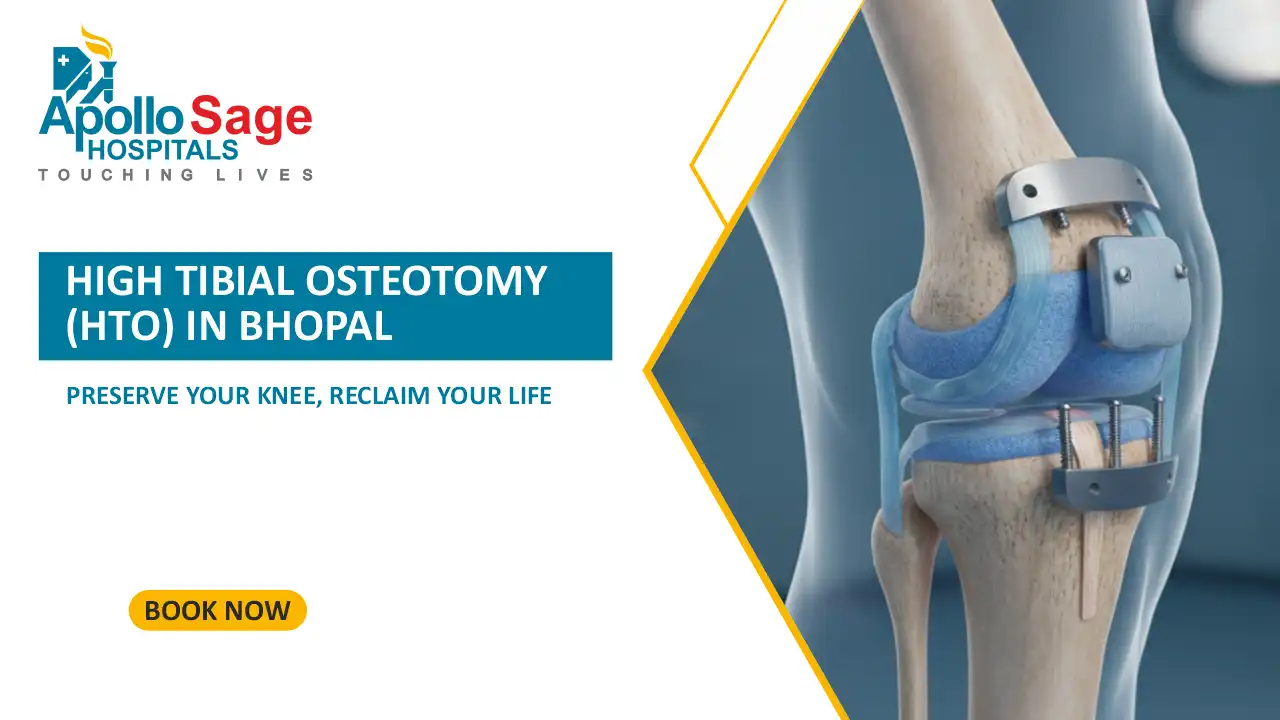
High Tibial Osteotomy (HTO) is a surgical knee preservation procedure in which the upper shinbone (tibia) is precisely cut and realigned to correct a varus (bow-leg) deformity. By shifting the body's mechanical axis, HTO transfers weight-bearing load from the damaged medial compartment to the healthier lateral compartment - relieving pain, slowing arthritis progression, and preserving the natural knee joint without any implant or prosthesis. It is the gold-standard alternative to early knee replacement for active patients aged 40-60.
In a healthy knee, the body's mechanical axis passes through the centre of the joint, distributing load evenly. In patients with varus deformity (bow legs), this axis passes medially - concentrating 60-80% of body weight on the inner (medial) cartilage. Over time this accelerates medial compartment osteoarthritis. HTO interrupts this destructive cycle at its root by repositioning the tibia so that load shifts to the intact lateral compartment.
KEY FACTS: HIGH TIBIAL OSTEOTOMY
- + Corrects varus (bow-leg) deformity by repositioning the upper tibia
- + Shifts load from damaged medial to healthy lateral compartment
- + Preserves natural knee - no bone removed, no prosthesis
- + Allows full activity including sport, farming, and manual work
- + Delays or avoids knee replacement by 10-15 years in suitable patients
- + If TKR is ever needed, it can still be done as a standard primary procedure
- + Best outcomes in active patients aged 40-60 with isolated medial disease
Who Needs HTO? - Ideal Candidate Profile
Criteria Favouring HTO Surgery
- + Age 40-60 years (younger patients with severe varus also benefit)
- + Isolated medial compartment osteoarthritis (Kellgren-Lawrence Grade 1-3)
- + Varus (bow-leg) deformity confirmed on standing alignment X-rays
- + Good range of motion (>90 degrees flexion, full extension)
- + BMI under 32
- + Healthy lateral compartment and patellofemoral joint
- + No inflammatory arthritis (rheumatoid, psoriatic)
- + Active patient wanting to return to sport or heavy work
- X Tricompartmental arthritis (HTO NOT recommended)
- X BMI > 35 (HTO NOT recommended)
- X Inflammatory arthritis (HTO NOT recommended)
Types of High Tibial Osteotomy
Opening Wedge HTO
A single cut is made on the medial side of the tibia, gently opened to the precise correction angle, and stabilised with a titanium locking plate (Tomofix). No bone is removed. New bone fills the gap over 3-4 months. Advantages: Precise, adjustable correction; bone preserved; allows simultaneous cartilage procedures; easier conversion to TKR if needed.
Closing Wedge HTO
A bone wedge is removed from the lateral tibia; the gap is closed and fixed. Reliable bone-to-bone healing; decades of long-term data. Requires fibular osteotomy; less precise correction; makes future TKR more demanding. Used for large corrections or select anatomical situations.
QUICK SUMMARY: HTO TYPES
- -> Opening Wedge: cut medial side, hold open with plate - preferred by Dr SK Gupta at Apollo Sage Bhopal
- -> Closing Wedge: wedge removed lateral side - reliable healing, used in select large corrections
- -> Both types shift mechanical axis from damaged medial to healthy lateral compartment
- -> Choice depends on degree of correction needed and individual patient anatomy
HTO vs Total Knee Replacement - Comparison
| Factor | HTO (Knee Preservation) | Total Knee Replacement |
| Best Age | 40-60 years | 60+ years |
| Natural Knee | Preserved - no implant | Replaced with prosthesis |
| Activity | Full incl. sport & manual work | Moderate - avoid high impact |
| Sports Return | Yes - 4-6 months | Limited - no contact sport |
| Disease Pattern | Isolated medial compartment | Tricompartmental arthritis |
| Future Options | Bone preserved; TKR still possible | Revision TKR (complex) |
| Implant Life | No implant to wear out | 15-25 years (revision needed) |
| Hospital Stay | 2-3 days | 3-5 days |
Key Principle: For a 45-year-old active patient with medial compartment arthritis and a varus knee, HTO is almost always the better first surgical choice. It preserves the natural joint, allows unrestricted activity, and keeps the door to a future knee replacement fully open. A TKR at 45 will likely need revision by 65 - a far more complex surgery.
Why Apollo Sage Hospital Bhopal Lead Nationally
DR SK GUPTA, APOLLO SAGE BHOPAL FAANA-awarded (first in India) - elite arthroscopy & joint preservation Fluoroscopy-guided precision HTO; international-grade Tomofix implants Abhinav Bindra Foundation Trust - Centre of Excellence for Sports Surgeries Combined HTO + cartilage restoration in single sitting Dedicated sports physiotherapy rehabilitation unit at Apollo Sage Bhopal Teleconsultation for outstation patients; rehab protocol handover.
The HTO Procedure: Step-by-Step at Apollo Sage Hospital, Bhopal
Pre-Operative Planning - No Guesswork
Every HTO begins with comprehensive pre-operative assessment: long-leg standing (HKA) X-rays to measure the mechanical axis deviation and calculate the precise correction angle; MRI knee to assess cartilage integrity in all three compartments; and digital templating using validated surgical planning software. This meticulous preparation is what ensures surgical precision.
Surgical Steps (Opening Wedge HTO)
- -> Anaesthesia: Spinal or general; tourniquet for bloodless field
- -> Incision: 5-7 cm on medial side of upper tibia, below joint line
- -> Tibial Osteotomy: Precision cut under continuous fluoroscopic guidance; lateral cortex preserved as hinge
- -> Controlled Opening: Calibrated spreaders open osteotomy to planned correction angle - verified with
- alignment rod
- -> Plate Fixation: International-grade titanium locking plate (Tomofix) applied and locked rigidly
- -> Concurrent Procedures: Cartilage restoration, ACL or meniscus repair performed in same sitting if planned
- -> Wound Closure: Layered closure; compression bandage; physiotherapy begins Day 1
HTO Recovery Roadmap - Your Complete Timeline
After HTO at Apollo Sage Hospital Bhopal, most patients use crutches for 6-8 weeks until X-rays confirm bone healing. Full weight-bearing resumes at 10-12 weeks. Return to desk work at 6-8 weeks; sport and manual work at 4-6 months. Complete recovery and full sport participation at 6-9 months.
| Phase | Timeline | Key Milestones |
|---|---|---|
| Immediate Post-Op | Day 0-3 | Discharge; crutches; brace; physio Day 1 |
| Protected Mobilisation | Week 1-6 | Partial weight-bearing; ROM 0-90 degrees; wound care |
| Full Weight-Bearing | Week 6-12 | X-ray confirms healing; brace weaned off |
| Strengthening | Month 3-4 | Cycling; swimming; progressive quad/hamstring |
| Functional Return | Month 4-6 | Jogging; manual work clearance; sport-specific training |
| Full Sport Return | Month 6-9 | Competitive sport; X-ray full consolidation confirmed |
Bone Healing Note: HTO healing follows bone biology - new bone fills the osteotomy gap over 3-4 months. Dr SK Gupta's team monitors healing with serial X-rays and only clears progressive loading once radiologically confirmed. Rushing this timeline risks loss of correction or implant failure.
Patient Experiences at Apollo Sage Hospital, Bhopal
Representative experiences based on the documented outcomes and reputation of Dr SK Gupta and Apollo Sage Hospital, Bhopal. Individual results vary.
I was 48 and had been told by two surgeons I needed a knee replacement. Dr SK Gupta at Apollo Sage Bhopal took one look at my standing X-rays and said HTO was the right answer. Eight months later I was back playing doubles tennis. I cannot believe I nearly had a replacement at 48.
***** Vikram S., 48 | Tennis Player, Delhi
I had bow legs since childhood and developed knee pain at 42. Dr Gupta explained the full picture - my varus deformity was overloading my inner knee. The HTO was flawless. I walked without pain for the first time in years at 3 months.
***** Meenakshi R., 42 | Teacher, Bhopal
I am a farmer and my livelihood depends on physical work. I refused a knee replacement at 52. Dr SK Gupta performed HTO at Apollo Sage Hospital and I returned to full farming at 6 months. The Bhopal facility is genuinely world-class.
***** Ramsahai P., 52 | Farmer, Vidisha, Madhya Pradesh
KEY TAKEAWAYS - HIGH TIBIAL OSTEOTOMY IN BHOPAL
- * HTO is gold-standard knee preservation for active 40-60 year olds with medial arthritis & varus deformity
- * Corrects mechanical axis, shifts load to healthy cartilage - no implant, no replacement
- * Opening wedge HTO with locking plate is the modern preferred technique
- * Good-to-excellent outcomes in 80-90% of patients; benefits last 10-15 years
- * Allows full unrestricted activity including sport, farming, and manual work
- * Future TKR, if ever needed, can still be done as a standard primary procedure
- * Dr SK Gupta at Apollo Sage Hospital Bhopal - India's first FAANA surgeon - is the top choice for HTO
- * Patients from Delhi, Mumbai, Hyderabad & Bangalore travel to Bhopal for Dr Gupta's care
Frequently Asked Questions
What is High Tibial Osteotomy (HTO)?
A: HTO is a surgical knee preservation procedure where the upper tibia is precisely cut and realigned to correct varus (bow-leg) deformity. By shifting the mechanical axis, HTO transfers body weight from the damaged medial compartment to the healthy lateral compartment - relieving pain, slowing arthritis, and preserving the natural knee without any implant. It is the gold-standard alternative to early knee replacement for active patients aged 40-60.
Who is a good candidate for HTO surgery in Bhopal or India?
A: The ideal HTO candidate is aged 40-60, physically active, with isolated medial compartment osteoarthritis (Grade 1-3) and varus deformity on standing alignment X-rays. They should have BMI under 32, healthy lateral compartment, no inflammatory arthritis, and a strong desire to preserve their natural knee. Dr SK Gupta at Apollo Sage Hospital, Bhopal evaluates each patient with full imaging before recommending HTO.
How long does HTO surgery recovery take in India?
A: After HTO at Apollo Sage Hospital Bhopal, most patients use crutches for 6-8 weeks. Full weight-bearing resumes at 10-12 weeks when X-rays confirm healing. Desk work return at 6-8 weeks; sport and manual work at 4-6 months. Complete recovery and full sport clearance at 6-9 months following Dr SK Gupta's personalised rehabilitation programme.
Is HTO better than knee replacement for younger patients?
A: For appropriately selected young, active patients with isolated medial arthritis and varus deformity, HTO is generally preferable. It preserves the natural joint, allows full physical activity including sport and manual work, preserves bone stock, and avoids prosthetic activity restrictions. Studies show good-to-excellent results lasting 10-15 years in suitable candidates.
Does HTO avoid knee replacement permanently?
A: HTO significantly delays knee replacement - often by 10-15 years. In some patients with well-preserved cartilage, it avoids replacement entirely. Importantly, since HTO does not remove bone, patients who eventually need TKR after HTO can still undergo a standard primary total knee replacement.
What is opening wedge HTO and how is it different from closing wedge?
A: Opening wedge HTO cuts the medial tibia, opens the gap to achieve correction, and holds it with a titanium locking plate - no bone removed. It is Dr SK Gupta's preferred technique at Apollo Sage Bhopal. Closing wedge HTO removes a bone wedge from the lateral side and is used for large corrections or specific anatomical situations.
Can HTO be combined with other knee procedures?
A: Yes. HTO is frequently combined with cartilage restoration (microfracture, OATS, ACI), ACL reconstruction, or meniscus repair in the same surgical sitting. Apollo Sage Hospital Bhopal has the full infrastructure for complex combined procedures under Dr SK Gupta's expertise.
How is varus knee deformity related to HTO?
A: Varus deformity concentrates 60-80% of body weight on the medial knee compartment, accelerating cartilage wear. HTO corrects this by shifting the mechanical axis into slight valgus, redistributing load to the healthier lateral compartment - reducing pain, slowing degeneration, and restoring near-normal function.
What complications can occur after HTO surgery?
A: HTO has a low complication rate in experienced hands. Risks include delayed bone union (uncommon with modern plating), implant discomfort (plate removal possible), infection (<1%), and neurovascular injury (extremely rare). Dr SK Gupta's fluoroscopy-guided technique and international-grade implants minimise all these risks.
Why is Dr SK Gupta the best HTO surgeon in Bhopal?
A: Dr SK Gupta is India's first FAANA-awarded arthroscopy and joint preservation surgeon with 21+ years and 12,000+ surgeries. At Apollo Sage Hospital Bhopal - a Centre of Excellence for Sports Surgeries (Abhinav Bindra Foundation Trust) - he performs HTO with fluoroscopy-guided precision and international-grade implants, with a dedicated sports rehabilitation team delivering globally benchmarked outcomes.
Can I travel from Delhi, Mumbai, or Hyderabad for HTO surgery in Bhopal?
A: Yes. Bhopal (Raja Bhoj Airport) has direct flights from Delhi, Mumbai, Bangalore, and Hyderabad. Apollo Sage Hospital Bhopal coordinates care for outstation and international patients. Dr SK Gupta's team provides teleconsultation and a complete home-city rehabilitation handover protocol for safe recovery.
How long do the benefits of HTO last?
A: Published studies report good-to-excellent outcomes in 80-90% of patients at 5 years and 70-80% at 10 years. Longevity depends on age, BMI, activity level, and cartilage preservation at surgery. Younger patients with well-preserved cartilage and excellent mechanical correction tend to achieve the longest-lasting results.
What exercises should I do after HTO surgery?
A: Post-HTO rehabilitation begins Day 1 with ankle pumps and quad sets. Weeks 2-6 introduce active range-of-motion. Weeks 6-16 add progressive strengthening (cycling, leg press). Month 4 starts jogging and balance work. Dr SK Gupta's sports physio team provides a written week-by-week protocol tailored to each patient.
Is there an age limit for HTO surgery?
A: HTO is most effective in patients aged 40-60 with good bone quality and isolated medial disease. However, there is no absolute cut-off. Younger patients with severe varus and early arthritis benefit greatly. Patients over 60 with excellent bone stock, isolated medial disease, and high activity demands may still be candidates. Dr SK Gupta assesses each patient individually.
Can the HTO plate be removed after surgery?
A: Yes. The titanium locking plate can be removed once full bone healing is confirmed - usually at 12-18 months post-surgery. Plate removal is a minor day-case procedure. Most patients who experience plate-related discomfort or subcutaneous prominence in lean builds opt for removal after bone consolidation is confirmed on X-ray.
Conclusion - Your Knee Deserves a Second Opinion
If you are an active person aged 40-60 with medial knee pain, a varus deformity, and a knee replacement recommendation on your desk - pause. High Tibial Osteotomy may be the better answer: preserve your natural joint, restore alignment, and keep doing everything you love for the next decade and beyond.
In Bhopal, Madhya Pradesh, that expertise lives at Apollo Sage Hospital, in the hands of Dr SK Gupta - India's first FAANA-awarded arthroscopy and joint preservation surgeon, with 21+ years, 12,000+ surgeries, and a dedicated team committed to your best outcome.
India's #1 HTO surgeon Dr SK Gupta (FAANA) at Apollo Sage Hospital, Bhopal. Avoid early knee replacement with precision varus correction.
ABOUT THE AUTHOR
Dr. S.K. Gupta is a Senior Orthopaedic, Knee & Shoulder Joint Surgeon at Apollo Sage Hospital, Bhopal, with 21+ years of experience and 12,000+ surgeries. He holds an MS in Orthopaedics (Mumbai) and international fellowships from Japan, Singapore, and Delhi. Widely known as the Meniscus Man of India, he is the first arthroscopy surgeon from India to receive the FAANA Fellowship and is recognised by the Abhinav Bindra Foundation Trust as a Centre of Excellence for Sports Surgeries.
