




AVASCULAR NECROSIS OF THE HIP SYMPTOMS STAGES ADVANCED TREATMENT OPTIONS
Avascular Necrosis of the Hip: Symptoms, Stages & Advanced Treatment Options
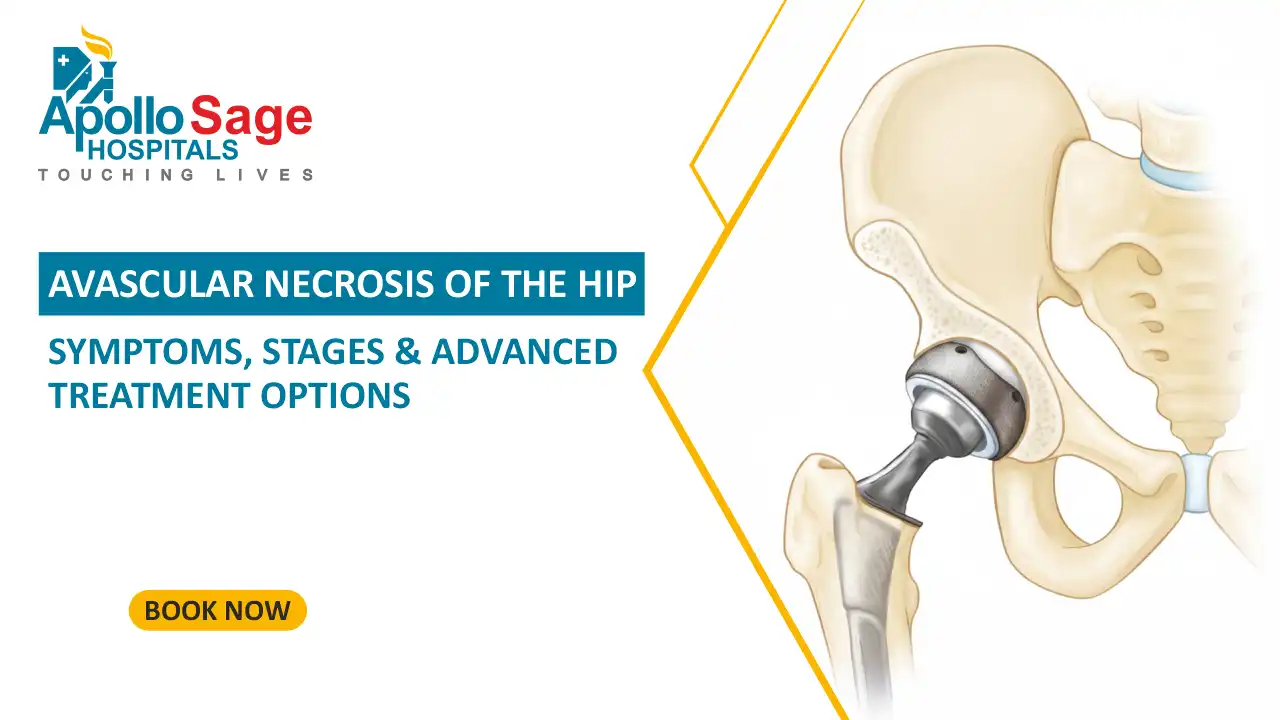
Dr. SK Gupta, Apollo Sage Hospital Bhopal, explains avascular necrosis of the hip - early symptoms, MRI diagnosis, stages, OSSGROW bone cell therapy, core decompression, and hip replacement. A complete guide for AVN treatment in India.
When the Hip Bone Silently Loses Its Blood Supply
Avascular necrosis of the hip - also called osteonecrosis of the femoral head - is one of the most underdiagnosed orthopedic conditions affecting people in India today. In my clinical practice at Apollo Sage Hospital, Bhopal, I regularly see patients who have been living with hip pain for months, sometimes years, before receiving an accurate diagnosis. By then, the femoral head has already begun to collapse. AVN most commonly strikes people in the prime of their lives: young adults aged 25-45, working professionals, and individuals recovering from steroid-based COVID-19 treatment. The question I hear most often: "Can I avoid a hip replacement?" The honest answer is yes - but only if we catch it early and act with the right treatment.
What Is Avascular Necrosis of the Hip?
Avascular necrosis (AVN), also referred to as osteonecrosis of the femoral head, is a condition in which blood supply to the femoral head is interrupted. Without adequate blood flow, bone cells begin to die. Over time structural integrity weakens, leading first to microscopic fractures and eventually to complete collapse of the femoral head - destroying the cartilage surface and ultimately requiring hip replacement surgery. Understanding the biology of AVN underpins why early-stage biological treatments - such as OSSGROW autologous osteoblast therapy and core decompression - are so effective when applied in time, and why delaying treatment so often leads to the operating room.
Early Symptoms of Avascular Necrosis of the Hip
The early symptoms of AVN can be deceptively mild. Patients frequently attribute their discomfort to a muscle pull or gym injury - and this delay is one of the leading reasons AVN progresses to advanced stages unnecessarily.
- Groin pain: The most common presenting complaint - a deep, aching discomfort in the hip or groin, worse with activity and relieved by rest in early stages.
- AVN hip pain while walking: As AVN advances, walking, stair-climbing, or rising from a chair become painful. Pain may radiate into the thigh or knee.
- Stiffness and reduced range of motion: Difficulty putting on shoes, crossing legs, or rotating the hip early signs of joint compromise.
- Pain at rest and at night: In advanced stages, pain becomes activity-independent. Night pain signals significant structural damage.
- Limp or altered gait: Patients unconsciously limp to avoid pain, causing secondary stress on the knee, lower back, and the opposite hip - sometimes triggering bilateral AVN.
Important: If you have a history of steroid use, alcohol consumption, recent hip trauma, sickle cell disease, or COVID-19 steroid treatment - seek evaluation immediately. In AVN, time is bone.
Stages of Avascular Necrosis of the Femoral Head
At Apollo Sage Hospital, Bhopal, we use the internationally accepted ARCO staging system. The stage at diagnosis directly determines treatment approach and likelihood of hip preservation.
| Stage | Finding | Treatment Approach |
|---|---|---|
| Stage 0 | Pre-clinical, biopsy only | Rarely diagnosed |
| Stage 1 | Normal X-ray; MRI shows marrow edema | OSSGROW + Core Decompression — ideal stage |
| Stage 2 | Sclerotic/cystic changes; head shape intact | OSSGROW + Core Decompression — high success |
| Stage 3 | Crescent sign; subchondral collapse begins | Hip Preservation Surgery (window narrowing) |
| Stage 4 | Femoral head collapsed; joint space narrows | Hip Replacement usually required |
| Stage 5 | Secondary osteoarthritis; joint destroyed | Total Hip Replacement — definitive treatment |
MRI Findings in Avascular Necrosis: The Gold Standard for Diagnosis
Plain X-rays appear entirely normal in Stage 1 and early Stage 2 AVN. MRI is the gold standard diagnostic tool for avascular necrosis of the hip.
Key MRI Signs
The characteristic finding is the "double line sign" on T2-weighted images - an inner high-signal and outer low-signal line representing the reactive interface between living and dead bone. Additional findings include bone marrow edema, subchondral fractures, and loss of the spherical contour of the femoral head in advanced cases.
MRI also measures the size and location of the necrotic lesion relative to the weight-bearing zone — directly influencing treatment decisions. In my practice at Apollo Sage Hospital, Bhopal, any patient with unexplained hip or groin pain lasting more than four to six weeks undergoes an MRI regardless of X-ray findings.
Causes of Avascular Necrosis in Young Adults
- Corticosteroid use: The single most common cause in India. Steroids disrupt fat metabolism, leading to fat emboli that block the femoral head's blood supply. Even short courses of high-dose steroids for COVID-19, autoimmune disease, or nephrotic syndrome can trigger AVN.
- Post-COVID AVN: Patients who received high-dose steroids during COVID-19 hospitalisation (2020-22) are now presenting with symptomatic bilateral AVN. AVN treatment after steroid use for COVID is one of the fastest-growing sub-specialties in Indian orthopaedics.
- Alcohol consumption: Heavy alcohol use impairs fat metabolism similarly to steroids, causing fat emboli and vascular occlusion.
- Trauma: Fractures of the femoral neck or hip dislocations can directly disrupt the blood vessels supplying the femoral head.
- Sickle cell disease: Sickling of red blood cells physically blocks microvascular flow to the femoral head.
- Idiopathic: In 20-30% of cases, no identifiable cause is found.
Non-Surgical Treatment for Avascular Necrosis Hip
For very early Stage 1 disease with small lesions, supervised non-surgical management may temporise the condition. Options include protected weight-bearing (crutches), bisphosphonate medications, lipid-lowering agents (statins), anticoagulation therapy, and physiotherapy to maintain joint mobility.
Important caveat: Non-surgical treatment alone does not regenerate dead bone. Studies consistently show that 80-90% of untreated AVN hips progress to femoral head collapse within two to five years. Can avascular necrosis of the hip be cured naturally? In genuine Stage 1 disease with a reversible cause, spontaneous improvement has been reported - but this is the exception, not the rule.
OSSGROW Bone Cell Therapy: Regenerative Treatment for AVN
Of all the advances in hip preservation surgery over the past decade, none holds more promise for early-to-mid stage AVN than OSSGROW - a DCGI-approved autologous osteoblast-based regenerative therapy.
What Is OSSGROW?
OSSGROW is a DCGI-approved bone cell therapy that uses the patient's own bone cells - osteoblasts - to regenerate dead bone tissue in the femoral head. A small bone sample is harvested from the patient, processed in a GMP-certified laboratory to culture a pure population of active osteoblasts, then implanted back into the necrotic zone of the femoral head - typically combined with core decompression surgery. Because it uses the patient's own cells, there is no risk of immune rejection.
Core Decompression with OSSGROW Implantation
This combination is the gold-standard treatment for Stage 1, Stage 2, and selected Stage 3 AVN. Core decompression creates a channel through the necrotic bone, relieving intraosseous pressure and providing a pathway for OSSGROW cells to be delivered directly into the zone of bone death. The result: new bone formation, structural recovery of the femoral head, and preservation of the patient's own joint.
OSSGROW Success Rate in AVN Hip
| AVN Stage | Core Decompression Alone | Core Decompression + OSSGROW |
|---|---|---|
| Stage 1 | 60-70% | 85-90% |
| Stage 2 | 55-65% | 80-88% |
| Stage 3A (crescent sign) | 40-50% | 65-75% |
Ideal Candidate for OSSGROW Therapy
The ideal OSSGROW candidate has Stage 1 or Stage 2 AVN with intact femoral head contour on MRI - typically a young adult (20-50 years) with post-steroid, post-COVID, or idiopathic AVN who is fit for minor surgery. Selected Stage 3A patients with early crescent sign may also benefit.
Cost Advantage: The cost of OSSGROW treatment in India is substantially lower than comparable regenerative bone cell therapies available abroad — making this DCGI-approved biological treatment accessible to patients across India without compromise in quality.
Core Decompression vs Hip Replacement for AVN
Core Decompression - Hip Preservation Surgery
Core decompression is a minimally invasive hip preservation surgery in which a drill creates tunnels through the necrotic femoral head, decompressing elevated intraosseous pressure and stimulating healing. Combined with OSSGROW, PRP, or BMAC, it becomes a powerful biological regenerative procedure. Appropriate for Stage 1, 2, and selected Stage 3. Recovery involves 6-8 weeks of protected weight-bearing, with return to normal activity within 3-6 months.
Total Hip Replacement - When It Is Needed
Total hip replacement (THR) is indicated when the femoral head has collapsed - typically Stage 3B, 4, and 5 AVN. Hip replacement for avascular necrosis success rate is high: modern implants achieve 15-20 year longevity. However, for a 30-year-old patient, even a successful THR may require revision in their 50s - making hip preservation strongly preferred whenever biologically feasible. For younger patients, ceramic-on-ceramic or ceramic-on-highly-crosslinked-polyethylene bearing surfaces are preferred for superior wear characteristics - designed to last 20-25 years with appropriate activity modification.
Bilateral Avascular Necrosis Hip: A Special Challenge
Bilateral AVN - affecting both hips - is increasingly common in post-COVID and post-steroid patients. Each hip must be staged independently, as they often present at different disease stages. Staged surgical procedures are typically recommended, allowing recovery between interventions. In bilateral Stage 1-2 disease, both hips may be treatable with OSSGROW and core decompression, completely avoiding hip replacement on either side.
How Fast Does Avascular Necrosis Progress?
Without treatment, 80-90% of AVN hips progress to femoral head collapse within 2-5 years. Post-steroid and post-COVID AVN can progress faster - within 12-18 months in high-dose steroid cases. This accelerated timeline is precisely why any patient with a new AVN diagnosis should not defer specialist assessment.
AVN Hip Treatment in Bhopal: Why Choose Dr. S.K. Gupta at Apollo Sage Hospital
With over 21 years of clinical experience and training across Japan, the USA, UK, Germany, and Singapore, I bring internationally accredited expertise to every patient I treat in Bhopal. My credentials include:
- FAANA - Fellow of the Arthroscopic Association of North America (USA): the only Indian arthroscopic surgeon to hold this distinction
- FIAS - Fellow of the International Arthroscopy Society (Japan)
- ISAKOS Accredited Teacher and Faculty Member
- Senior Member, Indian Arthroscopy Society | Member: ESSKA, ICRS, APKASS, IOA
- Former Assistant Professor of Orthopaedics - L.N. Medical College and J.K. Hospital, Bhopal
- Recognised by the Abhinav Bindra Foundation Trust as a Centre of Excellence for Sports Surgeries
At Apollo Sage Hospital, Bhopal, we offer the complete spectrum of AVN Surgery in Bhopal - from early-stage OSSGROW bone cell therapy and core decompression to complex bilateral hip replacement - all within a single centre of excellence in central India. Patients seeking the best doctor for AVN hip treatment in India travel from across Madhya Pradesh, avoiding the need to go to Mumbai or Delhi.
Frequently Asked Questions About AVN Hip Treatment
Q1. Can AVN be reversed in early stages?
Yes - in Stage 1 and Stage 2, the femoral head contour is intact. With timely OSSGROW bone cell therapy and core decompression, the necrotic zone can be repopulated with living osteoblasts, enabling genuine bone regeneration and functional reversal of the disease process. Early diagnosis is the single most critical factor.
Q2. Can OSSGROW cure AVN permanently?
OSSGROW achieves permanent bone regeneration by delivering active osteoblasts that form new, living bone. In the majority of eligible Stage 1-2 patients, the repaired femoral head remains structurally sound long-term with no requirement for further surgery or hip replacement.
Q3. Is hip replacement avoidable in AVN?
In Stage 1 and 2, and even selected Stage 3 cases, hip replacement is entirely avoidable with the right biological treatment. In Stage 4-5 with femoral head collapse, hip replacement is the appropriate and highly effective solution that restores quality of life.
Q4. What is the success rate of stem cell therapy in AVN?
Combined core decompression and OSSGROW/BMAC therapy achieves hip preservation success rates of 80-90% in Stage 1-2 AVN. Results depend on stage at treatment, lesion size, and underlying cause - post-steroid cases generally respond well once steroid exposure is eliminated.
Q5. Who is the ideal candidate for OSSGROW therapy?
Patients with Stage 1 or Stage 2 AVN with preserved femoral head contour on MRI — typically young adults (20-50 years) with post-steroid, post-COVID, or idiopathic AVN who are fit for minor surgery.
Q6. What is the difference between OSSGROW and regular stem cell therapy?
OSSGROW uses autologous osteoblasts — cells directly responsible for bone formation — already differentiated and ready to form bone. Broader stem cell therapies deliver undifferentiated cells that must still differentiate. OSSGROW's targeted approach results in more predictable, reproducible new bone formation.
Q7. Is bilateral AVN treated differently?
Each hip is staged independently. Staged procedures are typically recommended to allow recovery between surgeries. In bilateral Stage 1-2 disease, both hips can often be treated with OSSGROW and core decompression, avoiding replacement on either side.
Q8. How fast does AVN progress without treatment?
80-90% of untreated AVN hips progress to femoral head collapse within 2-5 years. Post-steroid and post-COVID AVN can progress within 12-18 months. Prompt specialist assessment is essential.
What Patients Say About Dr. S.K. Gupta - Best AVN Surgeon in Bhopal
"I am a basketball player from Nagpur. I had an injury that was not recovering despite treatment from many doctors. Dr. S.K. Gupta examined me, performed a small surgery, and after that not a single pain remained. I am back to my passion — my sport."
Pallav Singh Verified | Sports Injury | Nagpur
"Dr. S.K. Gupta explained everything thoroughly. After surgery I finally got rid of that massive pain. Galaxy Hospital is very neat and clean and all staff are so good. I really appreciate Dr. S.K. Gupta."
Ashok Lonkar Verified | Knee Surgery | Bhopal
"Dr. SK Gupta explained everything and was so inspiring — when I was crying in pain after surgery he motivated me and gave me emotional support. The nursing staff is very caring. I recommend Dr. SK Gupta to everyone with an ortho problem."
Verified Patient Verified | ACL Reconstruction | Bhopal
"Dr. S.K. Gupta is one of the most renowned and humble orthopedicians of Bhopal. I took my mother for knee pain treatment and we received professional advice. Highly recommended."
Vishal Singh Verified | Knee Pain Treatment | Bhopal
"Very nice doctor and treatment. My mother-in-law's operation was performed by Dr. Gupta and she was very happy with the successful outcome. We are grateful for his care."
Rashmi Shrivastava Verified | Joint Surgery | Bhopal
Patient Recommendation Rate 99% 572 verified reviews on Practo Read all reviews on Practo
Conclusion: The Right Time to Treat AVN Is Now
Avascular necrosis of the hip is not a condition to observe and hope will improve on its own. It is a progressive disease - and the evidence is unambiguous that early, biologically-targeted intervention gives patients the best chance of preserving their hip and avoiding replacement surgery. Whether you are a young professional diagnosed with post-COVID steroid-induced AVN, an athlete with unexplained hip pain, or a family member concerned about worsening groin symptoms - seek an expert opinion early, pursue accurate MRI-based staging, and explore all biological and surgical options. At Apollo Sage Hospital, Bhopal, my team and I are committed to offering every AVN patient the most advanced, evidence-based, and compassionate care available in India.
About the Author
Dr. S.K. Gupta is Senior Orthopaedic, Knee & Shoulder Joint Surgeon at Apollo Sage Hospital, Bhopal, with 21+ years of experience and 12,000+ surgeries performed. He holds an MS in Orthopaedics (Mumbai) and international fellowships from Japan, Singapore, and Delhi. Widely known as the Meniscus Man of India, he is the first arthroscopy surgeon from India to receive the prestigious FAANA Fellowship from North America, and is recognised by the Abhinav Bindra Foundation Trust as a Centre of Excellence for Sports Surgeries.
