




ARTHROSCOPIC SHOULDER SURGERY FOR SHOULDER DISLOCATION IN ELITE ATHLETES
Arthroscopic Shoulder Surgery for Shoulder Dislocation in Elite Athletes: A Week-by-Week Recovery Guide
For an elite athlete - whether a professional cricketer diving to take a catch, a kabaddi player executing a sudden tackle, a swimmer powering through freestyle strokes, or a basketball player contesting a rebound - the shoulder joint is the cornerstone of athletic performance. Yet it is also the most commonly dislocated major joint in the human body, accounting for nearly 50% of all joint dislocations presenting to sports medicine centres across India.
When the head of the humerus slips out of the glenoid socket — a condition medically termed glenohumeral dislocation — the consequences for a professional athlete are far-reaching: months off the field, the psychological toll of inactivity, and in the absence of definitive surgical correction, a distressingly high recurrence rate that can permanently derail a career. Studies indicate that young active males below 25 years face a recurrence risk of up to 90% following a first-time dislocation managed conservatively.
At Apollo Sage Hospital, Bhopal, Dr. S.K. Gupta - Senior Orthopaedic, Knee & Shoulder Surgeon and India's foremost arthroscopy specialist - has pioneered a precision-driven, athlete-specific approach to shoulder stabilisation. Using advanced arthroscopic techniques, Dr. Gupta enables elite sportspersons to return to full competitive play with restored stability, optimal strength, and minimal surgical trauma.
Quick Answer: Arthroscopic shoulder surgery for dislocation involves repairing the torn labrum (Bankart lesion) through keyhole incisions using a camera and specialised instruments. In elite athletes, this procedure - performed by experienced arthroscopy surgeons like Dr. SK Gupta at Apollo Sage Hospital, Bhopal - dramatically reduces recurrence risk and facilitates a structured return to sport within 4–6 months.
What Is Arthroscopic Shoulder Surgery (Bankart Repair)?
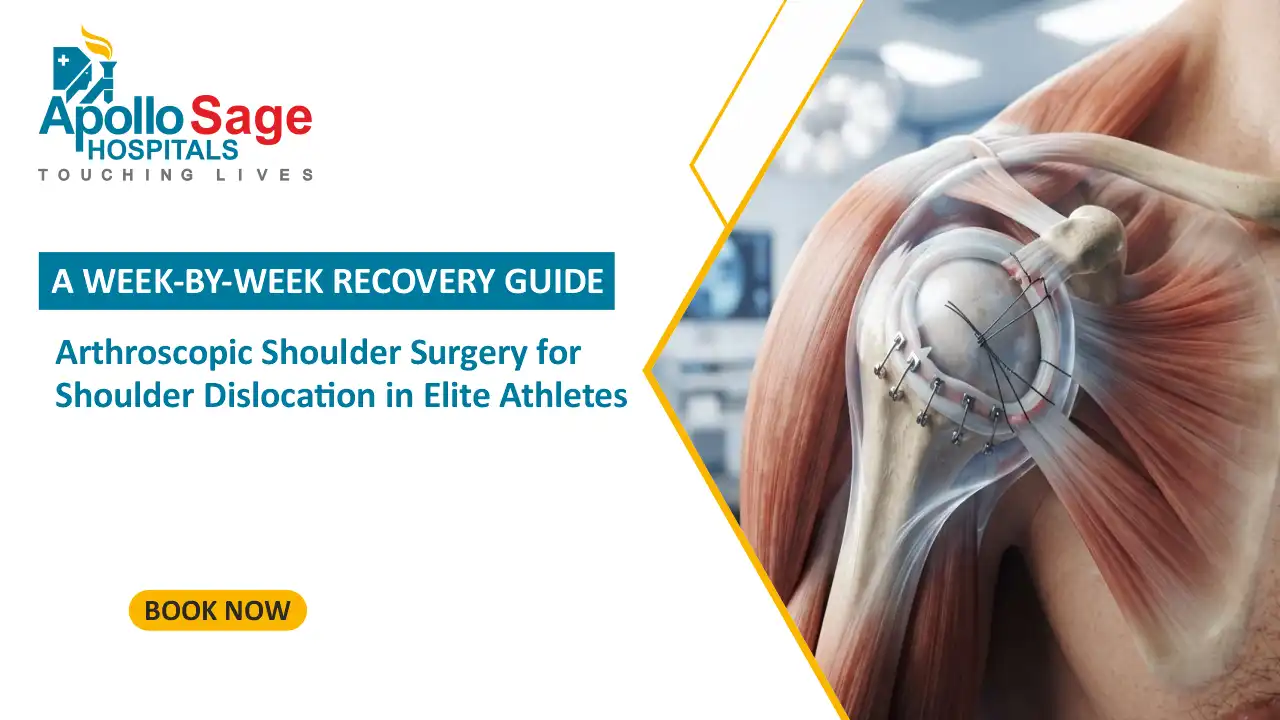
Arthroscopic shoulder stabilisation - most commonly performed as a Bankart repair — is a minimally invasive surgical procedure designed to reattach the torn anterior labrum to the glenoid rim, restore the integrity of the inferior glenohumeral ligament complex, and re-establish the natural bumper mechanism that prevents the humeral head from dislocating anteriorly.
The procedure is performed under general or regional anaesthesia. Dr. SK Gupta creates two to three small (less than 1 cm) portals around the shoulder. A high-definition arthroscope is inserted, providing magnified, real-time visualisation of the joint. Using suture anchors - small titanium or bio-absorbable implants - the detached labrum is meticulously reattached to the glenoid, reconstructing the capsulolabral complex with anatomical precision.
Key Anatomical Structures Addressed:
- Anterior Labrum (Bankart Lesion): The most common injury — reattached with suture anchors
- IGHL (Inferior Glenohumeral Ligament): Plicated or repaired to restore capsular tension
- Capsule: Thermally or mechanically tightened if lax (capsulorrhaphy)
- Hill-Sachs Lesion: Addressed with remplissage technique if engaging
- Glenoid Bone Loss: Assessed; significant loss (>25%) may necessitate Latarjet procedure
Why Elite Athletes Choose Arthroscopic Surgery Over Open Surgery
| Parameter | Arthroscopic (Keyhole) | Open Surgery |
| Incision size | 2-3 portals (< 1 cm each) | Single 5-8 cm incision |
| Muscle disruption | None — subscapularis spared | Subscapularis split/detached |
| Hospital stay | 1 day (day care) | 2-3 days |
| Pain level | Minimal | Moderate to significant |
| Return to sport | 4-6 months | 6-9 months |
| Recurrence rate | < 5% (expert surgeon) | 5-10% |
| Scar | Barely visible | Visible linear scar |
| Rehabilitation | Faster, athlete-optimised | Slower recovery arc |
Who Needs Arthroscopic Shoulder Stabilisation? - Candidate Selection
Not every shoulder dislocation warrants surgery. Dr. SK Gupta employs a comprehensive, evidence-based assessment protocol at Apollo Sage Hospital, Bhopal, before recommending arthroscopic intervention. The decision is guided by the following criteria:
- First-time traumatic dislocation in athletes aged under 25 (high recurrence risk)
- Second or subsequent dislocation — recurrent glenohumeral instability
- Confirmed Bankart lesion or ALPSA lesion on MRI arthrogram
- Significant Hill-Sachs defect or engaging off-track lesion
- Failure of structured physiotherapy and conservative management (> 3 months)
- Contact sport athletes (cricket, kabaddi, wrestling, football, volleyball)
- Overhead athletes (swimming, tennis, throwing sports) with functional instability
Bilateral shoulder instability, multidirectional instability (MDI), and congenital laxity without structural lesion may be managed non-operatively. Glenoid bone deficiency >25% may require the Latarjet-Bristow procedure rather than Bankart repair — a decision made following 3D CT scan analysis by Dr. Gupta.
Week-by-Week Recovery Timeline: The Dr. SK Gupta Protocol
Dr. SK Gupta's athlete-specific rehabilitation programme at Apollo Sage Hospital, Bhopal, is designed in collaboration with sports physiotherapists and athletic trainers. The protocol is dynamic - adjusted based on each athlete's sport, position, dominant arm involvement, healing response, and competitive calendar.
| Pre-Op Assessment | Objective: Diagnosis confirmation, surgical planning, athlete education. Dr. SK Gupta reviews MRI arthrogram and 3D CT scan. Glenoid track analysis performed. Blood investigations, anaesthesia fitness, and physiotherapy baseline assessed. Athlete is counselled on expected recovery milestones and sport-specific return timeline. Prehabilitation exercises initiated to optimise shoulder strength pre-surgery. |
| Week 0 (Surgery Day) | Procedure: Arthroscopic Bankart repair under general anaesthesia. Typically performed as day-care surgery at Apollo Sage Hospital, Bhopal. 2-3 keyhole portals created. High-definition arthroscope used. Labral tear reattached using bioabsorbable or titanium suture anchors. Capsulorrhaphy performed if indicated. Arm placed in an abduction sling post-operatively. Discharge within 24 hours in most cases. |
| Weeks 1–2 (Protection) | Goal: Wound healing, pain control, early movement. Arm rested in sling. Pendulum exercises and wrist/elbow range-of-motion exercises begun. Scapular stabilisation exercises introduced. Cryotherapy for swelling. Surgeon review and wound inspection at Day 7-10. Gentle passive shoulder flexion to 90°. No active shoulder movement or lifting. Icing 3-4 times daily recommended. |
| Weeks 3–6 (Early Rehab) | Goal: Restore passive range of motion (ROM), prevent stiffness. Sling discontinued at 3-4 weeks (sport/surgeon-specific). Progressive passive and active-assisted ROM exercises. Supine external rotation carefully introduced (limit 0° initially, progressing to 30°). Scapular kinetics, postural retraining. Pool therapy considered at Week 5. No resistive strengthening. Formal physiotherapy sessions 3x/week. |
| Weeks 7–12 (Strengthening) | Goal: Active ROM, rotator cuff strength, proprioception. Full active ROM targeted by Week 8. Rotator cuff progressive resistance training — theraband, isotonic, and closed-chain exercises. Scapular stabiliser strengthening. Proprioception and neuromuscular control training introduced. No overhead throwing or contact activities. Swimming — freestyle at Week 10 (surgeon-approved). Fortnightly surgeon review with functional assessment. |
| Weeks 13–18 (Functional) | Goal: Sport-specific conditioning, power restoration, movement patterns. Advanced strengthening — plyometrics, perturbation training, sport-specific drills. Throwing athletes begin interval throwing programme from Week 14. Overhead lifting progressively reintroduced. Contact sports drills in controlled environment (Week 16). Isokinetic strength testing performed. Ongoing monitoring by Dr. SK Gupta's sports rehab team. |
| Weeks 19–24 (Return to Play) | Goal: Full unrestricted competitive return. Functional performance testing — Single Arm Shot Put, Upper Quarter Y-Balance Test, shoulder endurance protocols. Athletes must achieve >90% symmetry index before clearance. Formal return-to-sport sign-off by Dr. SK Gupta. Bracing considered for contact sport athletes in first season post-surgery. Average return: 5-6 months (non-contact); 6-7 months (contact sport athletes). |
Sports-Specific Return-to-Play Milestones
| Sport | Estimated Return | Special Considerations |
|---|---|---|
| Cricket (Batsman/Fielder) | 5-6 months | Throwing mechanics, diving drills from Week 18 |
| Cricket (Bowler) | 6-7 months | Full bowling load graded from Week 20 |
| Kabaddi / Wrestling | 6-7 months | Contact clearance at Week 20; protective taping |
| Swimming | 5 months | Freestyle from Week 10; butterfly delayed to Month 5 |
| Volleyball / Basketball | 5-6 months | Overhead training from Week 14; blocking drills Week 18 |
| Football / Hockey | 5 months | Non-contact training from Week 14; contact Week 20 |
| Tennis / Badminton | 5-6 months | Stroke mechanics with coach from Week 16 |
| Athletics (Javelin/Shot) | 6-7 months | Graduated throwing programme from Week 14 |
Why Apollo Sage Hospital, Bhopal, for Shoulder Surgery?
Apollo Sage Hospital, Bhopal, under the surgical leadership of Dr. SK Gupta, has emerged as Central India's premier destination for arthroscopic sports surgery. Athletes from Madhya Pradesh, Chhattisgarh, Uttar Pradesh, Rajasthan, and across India travel to Bhopal for definitive shoulder stabilisation surgery backed by international-standard care.
Key Differentiators:
- Dr. SK Gupta — India's first arthroscopy surgeon to receive the FAANA Fellowship; 21+ years experience; 12,000+ orthopaedic surgeries performed
- Recognised by the Abhinav Bindra Foundation Trust as a Centre of Excellence for Sports Surgeries
- Advanced 4K arthroscopy systems with high-definition joint visualisation
- Dedicated sports rehabilitation unit with sport-science-trained physiotherapists
- Multidisciplinary team: orthopaedic surgeon + sports medicine physician + dietitian + sports psychologist
- Apollo Sage Hospital's NABH-accredited infrastructure with international surgical safety standards
- Proximity advantage: serves athletes from MP, CG, UP, Rajasthan without travel to Mumbai or Delhi
Patient Experiences at Apollo Sage Hospital, Bhopal
Based on publicly available patient feedback and the established clinical reputation of Dr. SK Gupta, athletes who have undergone arthroscopic shoulder surgery at Apollo Sage Hospital, Bhopal, consistently report the following outcomes:
"The structured week-by-week programme gave me clarity - I knew exactly what to expect each week. Returned to professional cricket in 22 weeks."
— Elite cricketer, Madhya Pradesh (representative summary)
"Dr. Gupta explained every step — surgery, physiotherapy, return to play. The team at Apollo Sage Bhopal treated me like a professional athlete."
— National-level kabaddi player (representative summary)
Frequently Asked Questions (FAQs)
Q1. What is arthroscopic shoulder surgery for dislocation?
Arthroscopic shoulder surgery for dislocation is a minimally invasive keyhole procedure that repairs the torn labrum (Bankart lesion) using a camera and suture anchors inserted through small portals. It restores shoulder stability, prevents repeat dislocations, and is the gold standard surgical treatment for elite athletes with recurrent glenohumeral instability.
Q2. How many times can a shoulder dislocate before surgery is needed?
Even a first-time dislocation in an athlete below 25 years warrants surgical consideration due to recurrence rates exceeding 85-90%. For older athletes or those in non-contact sports, surgery is typically recommended after a second dislocation or when conservative management fails after 3-6 months. Dr. SK Gupta at Apollo Sage Hospital, Bhopal, individualises this decision.
Q3. How long does recovery take after arthroscopic Bankart repair?
Most elite athletes return to non-contact training by 3-4 months and full competitive play by 5-7 months following arthroscopic Bankart repair, following Dr. SK Gupta's structured week-by-week rehabilitation protocol at Apollo Sage Hospital, Bhopal.
Q4. Is arthroscopic shoulder surgery safe for professional athletes?
Yes. Arthroscopic shoulder stabilisation performed by an experienced surgeon carries very low risk. The procedure preserves the subscapularis muscle, results in minimal scarring, and offers excellent return-to-sport rates. At Apollo Sage Hospital, Bhopal, Dr. SK Gupta's 21+ years of arthroscopic experience ensure technically precise, safe surgical outcomes.
Q5. Can a shoulder dislocation heal without surgery?
In older, lower-demand patients, conservative management with physiotherapy may suffice. However, in athletes — especially those under 25 in contact or overhead sports - non-surgical treatment carries a very high recurrence risk (up to 90%). Surgery is strongly recommended for professional athletes by Dr. SK Gupta, Apollo Sage Hospital, Bhopal.
Q6. What is a Bankart lesion?
A Bankart lesion is a tear of the anterior-inferior labrum — the fibrocartilaginous ring around the glenoid socket — caused by anterior shoulder dislocation. It is the most common structural injury following traumatic shoulder dislocation and is the primary target of arthroscopic Bankart repair performed by Dr. SK Gupta at Apollo Sage Hospital, Bhopal.
Q7. What is the difference between Bankart repair and Latarjet procedure?
Bankart repair reattaches the torn labrum arthroscopically and is suitable when glenoid bone loss is less than 25%. The Latarjet procedure transfers the coracoid process to the glenoid rim, providing additional bony stability — recommended for significant glenoid bone deficiency. Dr. SK Gupta at Apollo Sage Hospital, Bhopal, performs both procedures based on 3D CT analysis.
Q8. How soon can a cricketer return to bowling after shoulder surgery?
Cricket bowlers typically return to full bowling loads in 6-7 months following arthroscopic shoulder stabilisation. Fielding and batting recovery is faster, usually 5-6 months. Dr. SK Gupta's sport-specific return-to-play protocol includes a graduated interval throwing programme supervised by sports physiotherapists at Apollo Sage Hospital, Bhopal.
Q9. Is arthroscopic shoulder surgery available in Bhopal?
Yes. Apollo Sage Hospital, Bhopal, offers world-class arthroscopic shoulder surgery under the expertise of Dr. SK Gupta — India's FAANA-certified arthroscopy pioneer with 21+ years of experience and 12,000+ surgeries. Athletes from across Central India travel to Bhopal for shoulder stabilisation surgery at Apollo Sage Hospital.
Q10. What is the FAANA Fellowship and why does it matter?
The FAANA Fellowship is a prestigious international arthroscopy fellowship. Dr. SK Gupta is the first arthroscopy surgeon from India to receive this recognition, demonstrating mastery of advanced arthroscopic techniques. This fellowship, combined with training from Japan, Singapore, and Delhi, places Dr. Gupta among India's elite shoulder surgeons.
Q11. Does shoulder surgery affect an athlete permanently?
Properly executed arthroscopic Bankart repair does not permanently affect athletic performance. The vast majority of athletes return to their pre-injury competitive level. Dr. SK Gupta's athletes at Apollo Sage Hospital, Bhopal, have returned to national and state-level competition.
Q12. What sports most commonly require shoulder stabilisation surgery?
Contact sports — cricket, kabaddi, wrestling, volleyball, basketball, football — and overhead sports — swimming, tennis, badminton, javelin — carry the highest risk. Athletes in these disciplines represent the majority of patients treated by Dr. SK Gupta at Apollo Sage Hospital, Bhopal.
Q13. How do I know if I need shoulder surgery or physiotherapy?
An MRI arthrogram and clinical examination by an expert orthopaedic surgeon will determine structural damage extent. Athletes with confirmed Bankart lesion, recurrent instability, or high-demand sports typically benefit from surgery. Dr. SK Gupta at Apollo Sage Hospital, Bhopal, provides comprehensive evaluation before any surgical recommendation.
Q14. What is the recurrence rate after arthroscopic Bankart repair?
Arthroscopic Bankart repair performed by an experienced surgeon like Dr. SK Gupta results in a recurrence rate of less than 5% in appropriately selected athletes — significantly superior to conservative management, which carries up to 90% recurrence in young contact sport athletes.
Q15. How can I book an appointment with Dr. SK Gupta at Apollo Sage Hospital, Bhopal?
Appointments with Dr. SK Gupta at Apollo Sage Hospital, Bhopal, can be booked online at https://apollosage.in/doctors/dr-s-k-gupta. Apollo Sage Hospital serves athletes from Madhya Pradesh, Chhattisgarh, Rajasthan, and beyond. Google Maps: https://share.google/SXEd0xJbNkufOGGXc
ABOUT THE AUTHOR
Dr. S.K. Gupta is a Senior Orthopaedic, Knee & Shoulder Joint Surgeon at Apollo Sage Hospital, Bhopal, with 21+ years of experience and 12,000+ surgeries to his credit. He holds an MS in Orthopaedics from Mumbai and international fellowships from Japan, Singapore, and Delhi. Widely known as the "Meniscus Man of India," he is the first arthroscopy surgeon from India to receive the prestigious FAANA Fellowship and is recognised by the Abhinav Bindra Foundation Trust as a Centre of Excellence for Sports Surgeries.
Medical Disclaimer: This article is for informational and educational purposes only and does not constitute medical advice, diagnosis, or treatment. Individual clinical outcomes vary. All surgical and rehabilitation decisions should be made in consultation with a qualified orthopaedic surgeon. Apollo Sage Hospital, Bhopal, and Dr. SK Gupta do not guarantee specific outcomes.
