




A FIRST FOR BHOPAL THORACOSCOPIC REPAIR OF CONGENITAL DIAPHRAGMATIC HERNIA IN A NEONATE
A First for Bhopal: Thoracoscopic Repair of Congenital Diaphragmatic Hernia in a Neonate
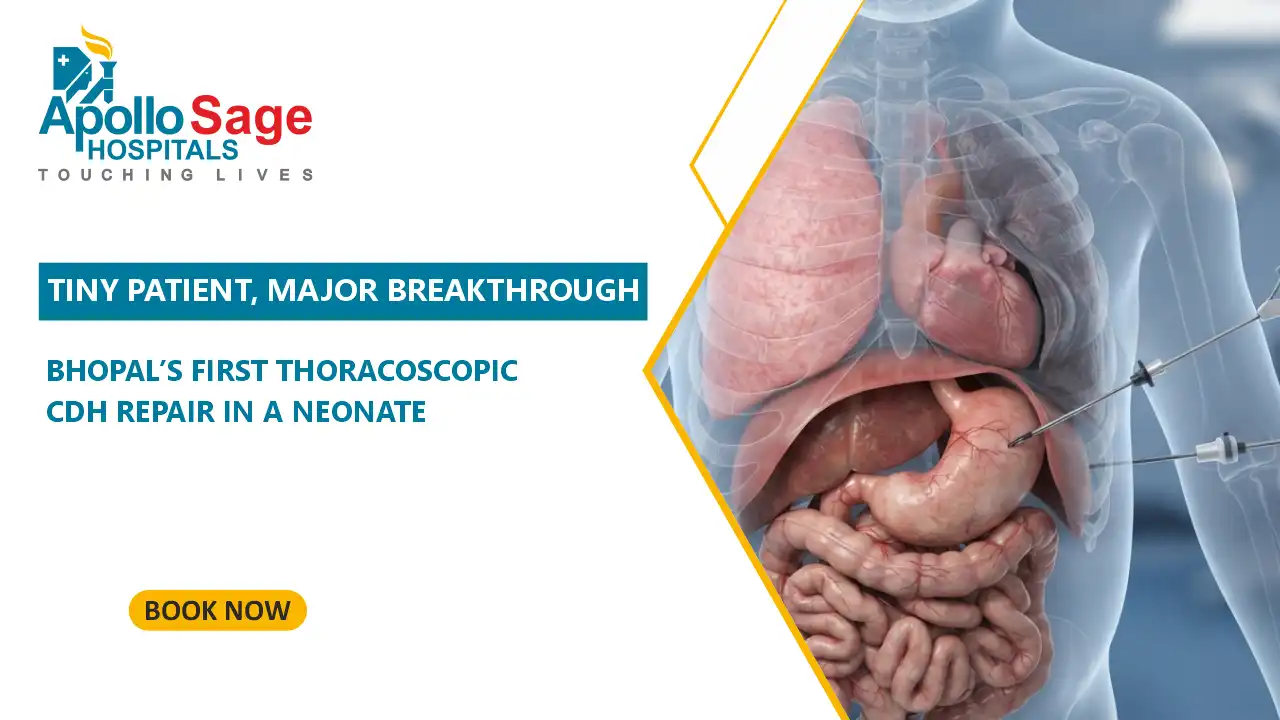
Congenital Diaphragmatic Hernia (CDH) is one of the most challenging conditions a neonatal surgeon can face. A defect in the diaphragm allows abdominal organs to herniate into the chest cavity, compressing the developing lungs and displacing the heart. Even in the best centres globally, it carries significant morbidity and mortality.
In May 2026, our department successfully performed what is believed to be the first thoracoscopic repair of CDH in Bhopal - in a 28-day-old female neonate weighing just 2.6 kg.
The Challenge
The baby presented with poor weight gain, recurrent feed regurgitation, and breathing difficulty. Imaging revealed a formidable picture: the spleen, small bowel, and large bowel had all herniated through a 4 cm diaphragmatic defect into the left chest, with the spleen lying malrotated alongside the heart and bowel loops reaching the apex of the thoracic cavity. Remarkably, the heart had been pushed entirely to the right side.
What made surgical planning particularly demanding was the sheer volume of herniated content, the malrotated spleen — which carries a significant risk of bleeding if handled carelessly - and the fragility of a neonate this size and age on the operating table.
Why Thoracoscopy?
Traditionally, CDH repair has been performed through open surgery - either a chest or abdominal incision. While effective, open repair carries greater physiological stress, longer recovery, and significant scarring in a newborn.
Thoracoscopic repair - operating through keyhole ports placed between the ribs - demands an entirely different skill set. The working space inside a neonate's chest is barely the size of a tennis ball. Instruments must be manipulated with extreme precision in three dimensions, and suturing the diaphragm under thoracoscopic vision, in a 2.6 kg baby, requires both advanced laparoscopic training and considerable experience in neonatal MAS (Minimal Access Surgery).
This approach, while well-established at a handful of high-volume paediatric surgical centres globally, has not previously been performed for CDH in Bhopal.
The Operation
Working through a 5 mm camera port and two 3 mm working ports, the herniated bowel loops and spleen were carefully reduced back into the abdomen. The diaphragmatic defect was then repaired primarily — without the need for a synthetic patch — using interrupted Prolene sutures, under continuous thoracoscopic magnification. The entire procedure was completed under a controlled low-pressure pneumothorax of just 4 mmHg to protect the delicate neonatal cardiovascular and respiratory physiology.
Recovery and Outcome
The baby was extubated within 24 hours of surgery, off respiratory support by day two, and breastfeeding by day four. The intercostal drain was removed on day five, with a chest X-ray confirming complete bilateral lung re-expansion and a centralised heart — a dramatic contrast to the pre-operative film. She was discharged home on post-operative day seven, healthy and feeding well.
Significance
CDH repair by thoracoscopy in a neonate represents the confluence of neonatal anaesthesia, intensive care, and advanced minimal access surgical technique. It demands not just technical skill but sound surgical judgement — knowing when thoracoscopy is appropriate, and having the experience to see it through safely. Bringing this capability to Bhopal means that families in central India no longer need to travel to distant tertiary centres for complex neonatal surgical care.
This case marks a meaningful step forward for paediatric surgical services in our region.
For queries regarding complex neonatal and paediatric surgical conditions, contact the Department of Paediatric Surgery, Apollo Hospitals, Bhopal.
Dr. Apoorv Singh MCh (AIIMS, New Delhi), F.MAS, D.MAS Consultant Paediatric Surgeon · Apollo Hospitals, Bhopal
